


A popular pick can feel like evidence before it has earned that status. A team appears on most prediction cards, sits above its opponent in community polls, or dominates discussion before a match.
Agreement may reflect many people reaching the same conclusion independently. It may also reflect one early opinion being repeated until it looks like consensus.
The useful question is therefore not how many people chose the same outcome, but how those choices were formed.
Research on online geopolitical forecasting offers a useful starting point. A Frontiers in Psychology study noted that crowd effects depend on multiple independent forecasts.
It also warned that cognitive fatigue may reduce the variance and independence of individual predictions.
The experiments involved novice forecasters working on geopolitical questions, so they do not establish a rule for match prediction, but the principle is still useful: a large collection of answers adds less information when participants are copying the same source, using the same shortcut, or simply repeating earlier selections.
A Popular Pick Is Not Always a Crowd Forecast
Pick’ems make this distinction especially relevant because they turn individual match calls into a public activity. A popular selection may reflect many separate judgements, but it may also grow after participants encounter rankings, expert picks, or prevailing opinion.
Before treating a majority as useful evidence, ask whether the choices were independent and whether they were based on relevant information.
That question becomes more concrete in CS2 betting, where a recent win-loss record isn’t enough to explain a match by itself. Format, quality of opposition, roster continuity, and map-specific performance can all change how convincing “form” really is.
A better process is to record an initial prediction and its supporting evidence before checking public selections. If the crowd agrees, compare the reasons rather than treating agreement as confirmation. If it disagrees, look for details you may have missed.
This is what makes CS2 betting a useful setting for examining crowd judgement: the same majority can represent many independent assessments, one widely repeated opinion, or a mixture of informed and low-information choices.
A changed view carries more weight when the new evidence can be named. Changing only because a leaderboard looks one-sided reveals social influence more clearly than a weakness in the original analysis.
A World Championship Pick’ems post shows how this comparison becomes part of the fan experience. Participants were invited to predict match outcomes and climb a leaderboard, turning private selections into visible performance.
It directly illustrates the setting without proving that users saw other people’s picks before submitting.
Why Consensus Can Become Misleading
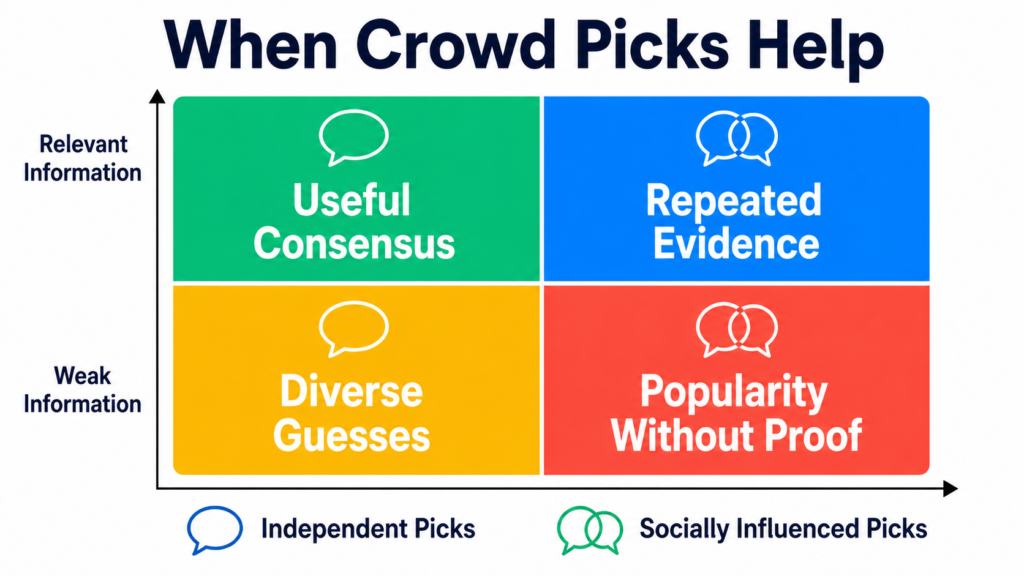
The visual shows why “follow the crowd” and “always oppose the crowd” are both poor rules. Independent, informed agreement deserves attention because different observers may notice different pieces of the same match.
Socially exposed agreement requires more caution. If most participants read the same preview, watched the same commentator, or saw the same percentage first, the apparent crowd may contain fewer genuinely separate judgments than its size suggests.
Public opinion can still be useful, provided its source is examined. Suppose a poll shows 70% support for one team.
That figure alone cannot reveal whether many independent analyses all arrived at the same conclusion independently, or whether many of them are just going along with what seems to be the consensus.
Ask what information could plausibly produce the agreement. A roster announcement, a format change, or repeated performance under comparable conditions may explain it. If no clear reason appears, the majority may be measuring visibility rather than quality.
Confidence should be treated in the same way. A strongly stated prediction can be well researched, but certainty is not evidence by itself.
Public agreement may also increase confidence after the reasoning has already been formed, making the final tone sound firmer than the original analysis deserved.
Keep the First Prediction Separate
A practical routine is to divide it into three stages: private view, public comparison, evidence check. Write the first prediction in a sentence, list a couple of the facts that carry the most weight, then inspect the consensus.
If the majority differs from your conclusion, identify the strongest arguments against your view. If the majority agrees, look for evidence that would still challenge the shared conclusion. This keeps agreement from ending the analysis too early.
Experimental work published by PLOS One helps explain the risk. In general-knowledge tasks, researchers found that social influence made error patterns less predictable and could turn confidence into a sign of consensus rather than accuracy.
Crowd picks are most useful when they are treated as another piece of evidence with a traceable origin. Recording the reason for any revision also makes the decision easier to review after the match, especially when the outcome itself tempts hindsight.
The decisive distinction separates independent information from repeated influence. A reader who keeps those apart can learn from agreement without mistaking popularity for proof.

