

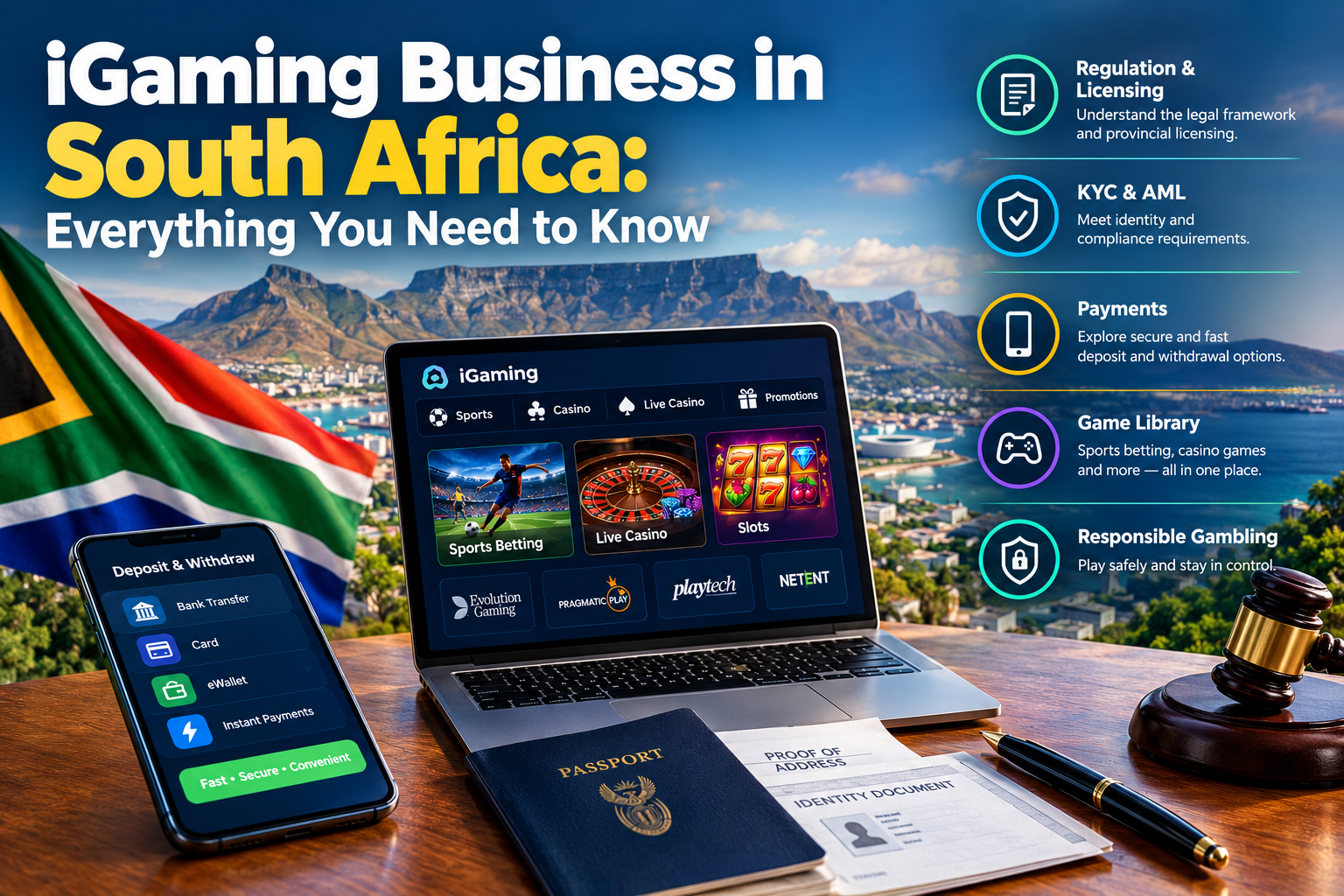
South Africa has one of the more developed gambling markets on the continent, and one of the more awkward legal set-ups. Sports betting is licensed and widely available. An online casino is not.
This guide maps the full entry cycle: the regulatory framework and provincial licensing, the compliance stack, the choice of platform, localised content, payments, player retention and marketing.
Read the legal sections first, because they decide what you can launch and when. Each section ends with practical steps you can act on, and the FAQ answers the questions operators ask most often.
The South Africa iGaming Market – Size, Opportunity, and African Context
Sports betting carries most of the commercial weight. According to the National Gambling Board’s 2024/25 annual report, as reported by Sigma, gross gambling revenue reached ZAR 74.9 billion, and betting made up 70 per cent of it. That figure covers land-based and online gambling together, so treat it as a sense of scale, not a forecast for your own launch.
Mobile is how most South Africans will reach you, so build for it from day one. Test on mid-range phones and patchy connections, not just your office Wi-Fi. The provincial licensing model also means a playbook from another African market will not transfer cleanly.
Nigeria, Kenya, Tanzania, Ghana and Zambia each have their own gambling rules, licensing structures and payment arrangements. South Africa combines a national framework with provincial licensing authorities.
That makes the licensing comparison useful, but revenue and mobile-use figures should only be compared when the countries use compatible definitions and reporting periods.
The NGB’s figures provide a baseline for South Africa; they do not, by themselves, establish that it is the largest or fastest-growing market in Africa.
iGaming Licenses South Africa – Regulatory Framework and Legal Structure
The National Gambling Act, 2004 (Act No. 7 of 2004) sets the foundation. The National Gambling Board (NGB) writes national standards and coordinates oversight.
Provincial licensing authorities issue the licences themselves, so market access is decided province by province, inside national rules. The NGB’s notice to provincial licensing authorities also addresses the status of remote gambling servers, which matters if your platform sits offshore.
The casino position is clear. On 27 February 2026, the NGB issued a media release and the notice above, stating that interactive and remote gambling remain unlawful and that online casinos have never been legal. In October 2025, the Supreme Court of Appeal, in Portapa (Pty) Ltd t/a Supabets v Casino Association of South Africa, held that bookmakers cannot offer bets on the outcomes of casino games.
The NGB reads the ruling more widely, and some attorneys dispute that reading, so take advice before relying on either interpretation.
Legal online casino depends on Parliament, and the picture is not tidy. The Democratic Alliance’s Remote Gambling Bill (B11-2024) was introduced in April 2024, and the Parliamentary Monitoring Group now lists it as lapsed.
A parliamentary update from 30 June 2026 says the private member’s bill has not been revived. The National Gambling Amendment Bill, first introduced in 2018, was endorsed by both committees in June 2025 after going to mediation.
Some industry commentary still expects a remote gambling bill in 2026, so keep watching both bills before you commit money to a casino product.
Gambling taxes, including VAT, depend on the product and the province. The rate that applies to your products should be confirmed with a tax adviser before you set prices or budgets. No rate is quoted here.
Provincial Licensing Process – Requirements, Costs, and Timelines
Provincial licensing is your route into sports betting. The Western Cape Gambling and Racing Board is one of the more active licensors, and many operators build their base there before they plan advertising and acquisition elsewhere. Do not assume that recognition carries across provinces. Get it in writing.
Expect to provide company documents, background checks on key people and evidence that your compliance systems work. The Western Cape Board’s processing notice confirms that POPIA applies to licence holders, and its forms include suitability affidavits.
Fees and processing times change, so take the current figures from the licensing authority rather than from a guide. [Insert the WCGRB application fee range and processing time once confirmed.] Budget for background checks, legal advice and compliance systems alongside the fee.
Use this checklist before you apply:
- Decide which province will hold your primary licence, and confirm in writing whether other provinces will recognise it.
- Obtain the current fee schedule and processing times from the licensing authority.
- Assemble company documents and a clear ownership structure.
- Prepare background-check packs for every key person.
- Draft your compliance manual (KYC, AML, POPIA and responsible gambling) before you submit.
- Map each payment method to your KYC and AML checks.
- Confirm affiliate and advertising rules with the regulator.
The order you work in matters. Background checks apply to people as well as the company, so settle your ownership structure and key appointments early.
Draft your compliance manual while the application is with the board, and expect questions on it. Operators who leave policy writing until approval tend to lose time they can’t easily get back.
KYC, AML, GDPR, and Responsible Gambling Compliance
KYC checks and AML controls need to work from the first deposit, not after launch. Identity checks, transaction monitoring and record-keeping are easier to get right when they are designed together.
Data protection in South Africa runs under the Protection of Personal Information Act (POPIA), not the European GDPR. The Information Regulator enforces it, and provincial licence holders are bound by it. Deposit limits and self-exclusion belong inside the product.
The sponsor of the Remote Gambling Bill has also called for age verification, data security, responsible gambling interventions and advertising rules, so build those into your platform choice now.
Sports Betting South Africa – Legal Status, Cross-Sell, and Omni-channel Potential
Sports betting is legal and widely offered through provincial bookmaker licences. The risk is mixing products. If your platform offers casino games alongside sports betting, those games cannot be delivered under a sports betting licence. The October 2025 Supreme Court of Appeal ruling and NGB enforcement make that position hard to defend.
Sports betting also raises its own player-protection questions. Live betting and frequent markets can pull customers into quick losses, so set account-level limits and watch session patterns from the first day, not after the first complaint.
A single player account across retail and online betting is worth building. It simplifies identity checks, responsible gambling limits and loyalty tracking, as long as your reporting can split retail from online activity. Esports betting is an obvious product for younger players.
Mobile-First Design and Payment Localisation for South African Online Gambling
South Africa’s mobile-first pattern is about how people get online. Localisation is the other half of the experience: currency, language, server location and the payment methods players actually use. Get those right and you improve the product and the compliance position at the same time.
Progressive Web App (PWA) and Cloud Infrastructure for South African Players
A progressive web app (PWA) skips the app store and often loads faster on older handsets, which helps where data is expensive or the connection is weak.
Host close to your players to cut latency. Confirm where you store personal data, because POPIA applies to information about South African residents. SSL encryption protects data in transit and is what players and regulators expect to see.
Payment Gateways – ZAR Integration, Crypto, and Localised Methods
Settle in South African rand (ZAR) and offer the local methods players already use. Tie every method to your KYC and AML checks before you switch it on. A deposit channel you cannot link to a verified player is a compliance problem waiting to happen.
Crypto needs more care. The Financial Sector Conduct Authority declared crypto assets to be financial products in October 2022, but crypto is not legal tender in South Africa, as legal analysts explain.
Player Retention and Engagement Strategies in the South African iGaming Market
Bonuses and cashback can build loyalty, but only if the same system that tracks player value also watches for harm. A promotion that pushes frequency without limits creates regulatory and reputational risk.
Put deposit limits, cool-off periods and self-exclusion in the same engine, so you can pause an offer when a player starts to struggle.
Localised offers tend to land better than generic ones: ZAR amounts, the player’s language, and events people actually follow. Measure the uplift in your own cohorts, because no benchmark will tell you what will work for your audience.
Live dealer is a popular retention product elsewhere, but live casino is not open to a sports betting licence in South Africa, so leave it out of your plan for now.
iGaming Marketing Strategies and Affiliate Opportunities in South Africa
Affiliates can bring in sports betting customers, but advertising rules apply. Check with each provincial authority what affiliates can say, where they can promote and what disclosures they must make. Responsible gambling messaging belongs in the promotion itself, and audit your affiliates regularly rather than after a complaint.
Sports betting customers can also become a base for a later casino product, if the law allows one, and this exhaustive guide on how to start an online casino explains what that step involves. Local content works here: ZAR offers, campaigns that reflect how people talk and what they watch. Judge it on cost per acquisition and player quality, not on how good it looks.
Before you spend on design or marketing, answer three questions. Which province will hold your primary licence? How will your platform keep sports betting separate from any casino content? Who in your team owns POPIA compliance day to day? Clear answers to those three will shape almost every decision that follows.
South Africa gives you a lawful route into sports betting through provincial licensing, while online casinos remain prohibited. Operators who plan for POPIA, ZAR localisation, responsible gambling tools and provincial recognition will be ready to move if a remote gambling framework is passed. Take legal advice before any launch, and check every figure and rule against the regulator’s latest publications.
Frequently Asked Questions About the South African iGaming Market
Is online casino gambling legal in South Africa?
No. The National Gambling Board says online casinos have never been legal, and that remains true until Parliament passes a remote gambling framework. Operators should not launch casino products for South African players under the current law, and offshore sites do not change that position for the operator.
What license do I need to operate an online casino in South Africa?
None is available for online casinos today. Sports betting operators hold provincial bookmaker licences, and remote gambling licences appear only in draft legislation that has not been enacted. Plan your entry around the sports betting route until the law changes.
How do iGaming licenses in South Africa work at the provincial level?
The National Gambling Board sets national standards and coordinates oversight, while provincial licensing authorities grant the licences. Confirm recognition and advertising rules in every province you plan to serve, because a licence in one province does not automatically cover the others.
What is the best online casino platform provider for the South African market?
No platform can lawfully run online casino for South African players today. For sports betting, look for a provider that supports provincial licensing, POPIA-compliant data handling, ZAR payments and responsible gambling tools, and that can show its controls to a regulator.
Is sports betting in South Africa regulated differently from online casinos?
Yes. Sports betting is legal under provincial bookmaker licences, while online casino gambling is prohibited. That difference affects product design, marketing, payments and what a platform can offer on a single account.
What makes South African online gambling different from other African markets?
South Africa has a national framework with provincial licensing, and a regulator that has recently enforced the casino prohibition in writing. Other African markets have their own licensing and payment rules, so each needs its own legal review before you enter.

