

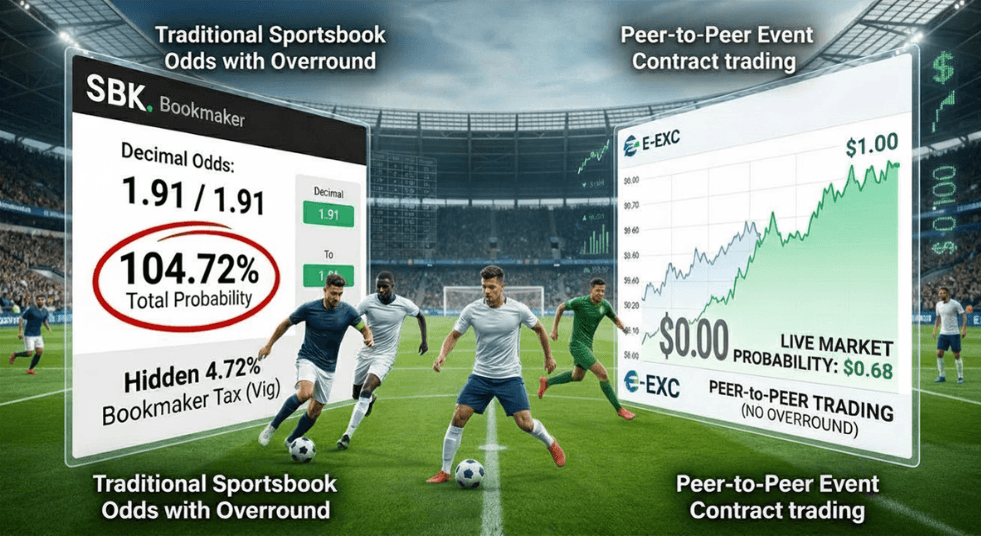
High-volume sports bettors recognize the impact of sportsbook overrounds on their bankroll. Also known as vig, juice, or a margin, this cost reduces profit as bookmakers ensure their profits by building an edge into odds.
Given this financial disadvantage of traditional sportsbook odds betting, bettors wanting to control their bankroll more effectively are turning to prediction markets and their peer-to-peer event contracts as a more financially astute alternative.
The hidden tax of the bookmaker’s overround
The bookmaker’s overround acts like a “tax” on bettors, as it creates implied probabilities that are higher than strictly fair probabilities would be.
For example, for a basic coin flip, the odds would be
Heads 2.00 decimal odds (50% probability).
Tails 2.00 decimal odds (50% probability).
So, in a fair outcome, the total odds add up to 100%.
However, traditional bookmaker prices reflect odds that exceed 100%, as an overround or margin is built in.
Looking at the previous coin flip example, a sportsbook might offer the following:
Heads 1.91 decimal odds (52.36% probability).
Tails: 1.91 decimal odds (52.36% probability).
This results in a total implied probability of 104.72%. The bookmaker’s overround is 104.72% – 100%, which is 4.72%. The lower the overround, the better value the odds are for bettors, because it makes profitable bets easier to find and reduces the amount of “commission” paid.
Peer-to-peer settlement as a disruptive financial alternative
For bettors seeking to eliminate the costly overrounds of bookmakers, prediction markets offer a disruptive financial solution. These markets operate using peer-to-peer contract trading, where users buy and sell contracts tied to real-world events, including sporting contests.
For example, contracts might refer to the question “Will Team X win the Championship?” These contracts trade between $0.00 and $1.00, based on true market probability. Trades finally settle at $1:00 if Team X wins, so the answer to the original question is “Yes” and $0.00 if Team X does not win, so the answer to the original question is “No.”
Bettors can buy and sell contracts at any point before this final settlement. An example of this is:
A “Will Team X win the Championship?” contract is trading at $0.68, reflecting an implied probability of 68%. A market user believes this probability is lower than the team’s actual chances of succeeding, so buys contracts at this price, believing they can make money either at final settlement or by selling once the price reaches a certain level.
Conversely, a user believes the contract price is too positive and that Team X is unlikely to win. So, they may decide to sell contracts in the hope of securing a profit before the price drops, potentially eventually to $0.00 on final settlement.
Prices change based on user reactions to current information. For sporting events, this could be an unexpected player injury or adverse weather conditions. No matter the eventual result, the implied overall percentage is never more than 100%, and unlike in sportsbook betting, there is no overround for bettors to consider.
Evaluating benefits and risks
Professional handicappers can eliminate the traditional bookmakers’ overround by transitioning their bankroll to this derivative style of event trading. Doing this requires an understanding of the benefits of the leverage crowd ‘wisdom’ or market sentiment involved in prediction markets, in addition to the potential risk of event contracts associated with them being all-or-nothing bets on uncertain outcomes. This makes them riskier than traditional investments like stocks or bonds.
To successfully diversify their strategy, dedicated bettors should also compare transaction fee models associated with prediction markets, evaluate order-book liquidity, and verify the regulatory compliance standards of the world’s leading event contract exchanges.
This analysis is essential for optimizing bankroll management, as lower fees have less impact on profits, and high liquidity results in smaller bid-ask spreads, less slippage, and easier entry and exit.

