

The Fundamental Problem With Certainty
Football occupies a strange position among major sports. Supporters, analysts and bettors devote enormous effort to finding an accurate football prediction, yet the game repeatedly produces results that appear to contradict the available evidence.
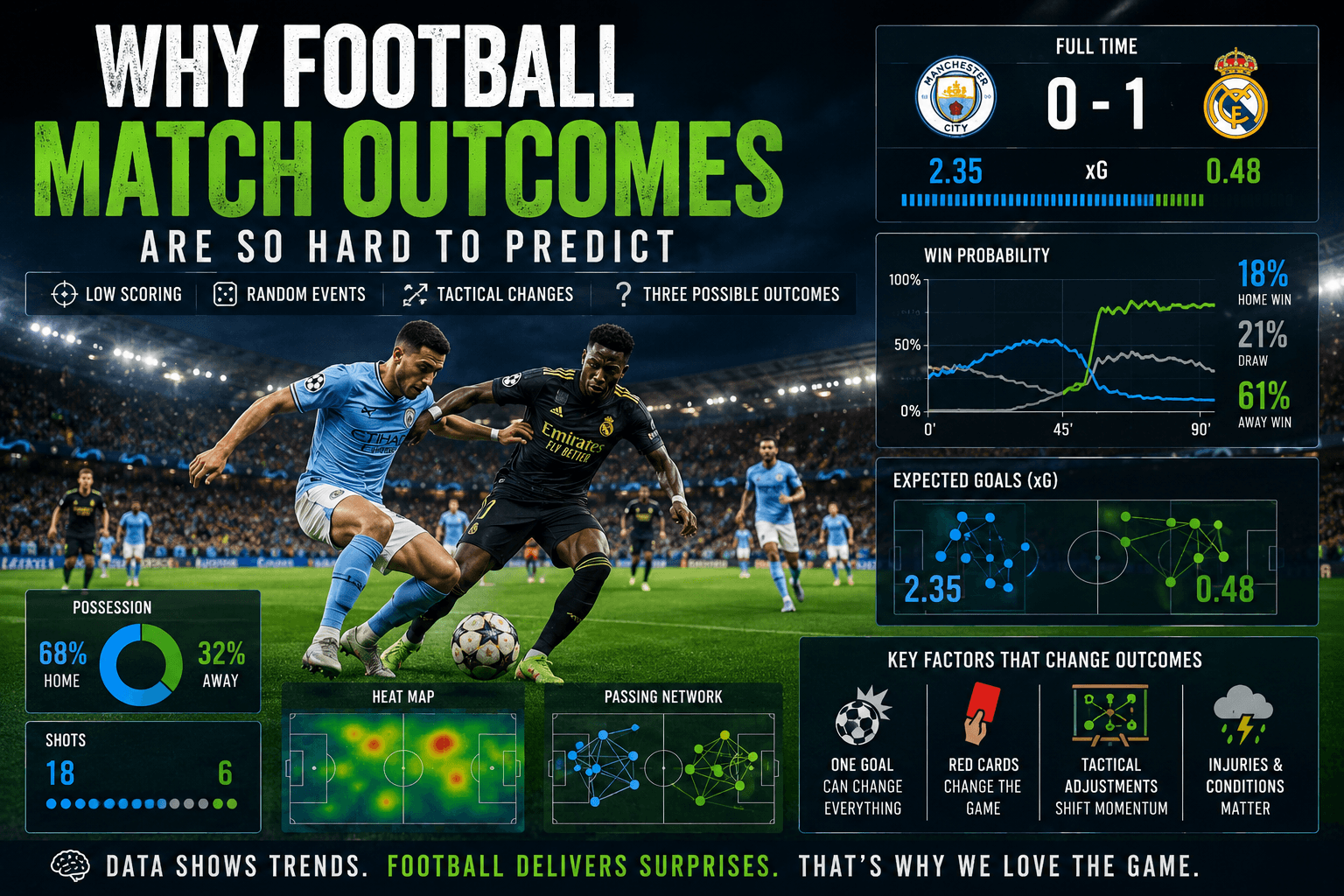
A dominant team can control possession, create the better chances and still lose to an opponent that attacks successfully only once.
A large-scale study published by Royal Society Open Science analysed 88,000 matches across 11 European leagues. It found that football’s predictability changes with the competitive balance between teams.
These patterns can be measured across thousands of fixtures, but they still cannot determine the outcome of one individual match.
This does not mean analysis is useless. It means that probability and certainty must be treated as different concepts. Data can show that one outcome is more likely than another, but it cannot reveal the result in advance.
Even a well-supported prediction describes a range of possibilities rather than a guaranteed event.
Football betting markets are built around this uncertainty. Readers exploring betting in Netherlands encounter the same fundamental limitation: odds and statistical models can rank possible outcomes, but neither can make a single result certain.
Why Low Scoring Creates So Much Volatility
Football matches usually contain relatively few goals. In basketball, tennis and several other sports, competitors have numerous opportunities to score or win points. Individual mistakes therefore tend to be diluted by everything else that happens during the contest.
Football offers far fewer decisive moments. A match can be determined by one shot, one defensive error or one refereeing decision. Because goals are rare, each goal has an unusually large effect on the final result.
Consider a team that creates several strong chances but fails to score. Its opponent may create only one comparable opportunity and convert it. The stronger overall performance has not disappeared, but it no longer determines the outcome.
Over an entire season, teams that consistently create better chances should generally perform better. Within a single match, however, finishing variation can overwhelm that advantage.
This is why match results often provide an incomplete picture of performance. Winning does not always mean that a team played better, just as losing does not always mean that its preparation or tactical approach was inferior.
Randomness Does Not Make Every Team Equal
Calling football unpredictable does not mean that every match is a coin toss. Differences in player quality, tactics, fitness, home advantage and recent performance all matter. A stronger team should still defeat a weaker opponent more often than it loses.
The difficulty lies in translating that long-term advantage into one specific result. If a team has a 65% chance of winning, defeat remains part of the forecast. It may be the less likely outcome, but it is not an impossible or even extraordinary one.
Across a large number of similar matches, a 35% failure rate would produce plenty of losing favourites.
This is where confidence is frequently misinterpreted. People tend to hear “most likely” and understand “almost certain.” When the less likely outcome occurs, they conclude either that the analysis was worthless or that something inexplicable happened.
In reality, the result may have fallen comfortably inside the uncertainty that was present from the beginning.
Decisive Events Change the Match Itself
A goal does more than alter the score. It changes the conditions under which the rest of the match is played.
A team that takes the lead may defend deeper, reduce the pace and accept less possession. The trailing side may push additional players forward and expose space behind its defence.
Pre-match expectations based on normal attacking and defensive patterns become less reliable because both teams are now behaving differently.
The same applies to red cards, penalties, team news and injury updates and unexpected tactical changes. These factors are not always completely random, but their timing and consequences are extremely difficult to forecast before kick-off.
An early dismissal can invalidate much of the analysis conducted under the assumption that both teams would play with eleven players.
Football is therefore not simply a collection of independent scoring opportunities. It is a sequence in which one event can reshape every event that follows. This path-dependent quality places another limit on models built mainly from historical averages.
The Additional Difficulty of the Draw
Football also requires prediction across three primary match outcomes: a home win, a draw and an away win. The draw is not merely an extra option added to two obvious alternatives.
It often emerges when the available signals are weakest and the teams are difficult to separate.
A draw can result from evenly matched performances, poor finishing, cautious tactics or one team cancelling out another despite having less individual quality. Very different matches can therefore produce the same final outcome.
Models can perform reasonably when identifying home and away victories while struggling to recognise draws consistently.
The statistical profiles associated with draws often overlap with those associated with narrow victories, especially when the teams have similar pre-match indicators.
The problem is not simply that random guessing has three possible answers. It is that the available data may not contain enough distinctive information to separate a draw from the two neighbouring outcomes.
What “High Probability” Really Means
The phrase high probability soccer prediction is meaningful only when the stated probability has been properly calibrated. If a model assigns a 70% probability to many comparable selections, approximately seven out of ten should succeed over time.
The other three failures do not automatically invalidate the model; they are part of what 70% means.
A percentage without context says very little. Readers need to know how it was produced, which market it applies to and whether similar probabilities have matched actual outcomes across a sufficiently large sample.
No probability should be presented as proof that a particular match will end in a particular way. The higher figure identifies the outcome supported by the available evidence, not the outcome football is obliged to produce.
How Prediction Claims Should Be Judged
Football prediction sites cannot eliminate match-level randomness. What they can do is communicate uncertainty honestly.
A responsible presentation should distinguish forecasts from guarantees, retain losing selections in its published record and evaluate performance across meaningful periods rather than isolated winning runs.
Results from different markets should not be combined to create a flattering headline percentage, and predictions should be recorded before kick-off so that unsuccessful picks cannot quietly disappear.
Transparency does not make an individual selection certain. It simply allows readers to judge whether the stated probabilities have behaved consistently over time.
The most useful question is therefore not whether a prediction will definitely win. No honest method can answer that. The better question is whether the available evidence has been converted into a realistic probability without hiding the possibility of failure.
Uncertainty Is Part of the Game
Football is difficult to predict because it combines low scoring, three possible match outcomes and a small number of events capable of transforming the contest.
Skill and analysis still matter, but their influence is easier to observe across many matches than within one isolated fixture.
Prediction becomes more rational when it stops pretending to offer certainty. A model can identify tendencies, compare possible outcomes and estimate their likelihood. It cannot prevent an unlikely event from occurring.
Variance is not a defect that better football prediction sites will eventually remove. It is a defining feature of the sport—and any serious interpretation of match probabilities must begin by accepting it.

