

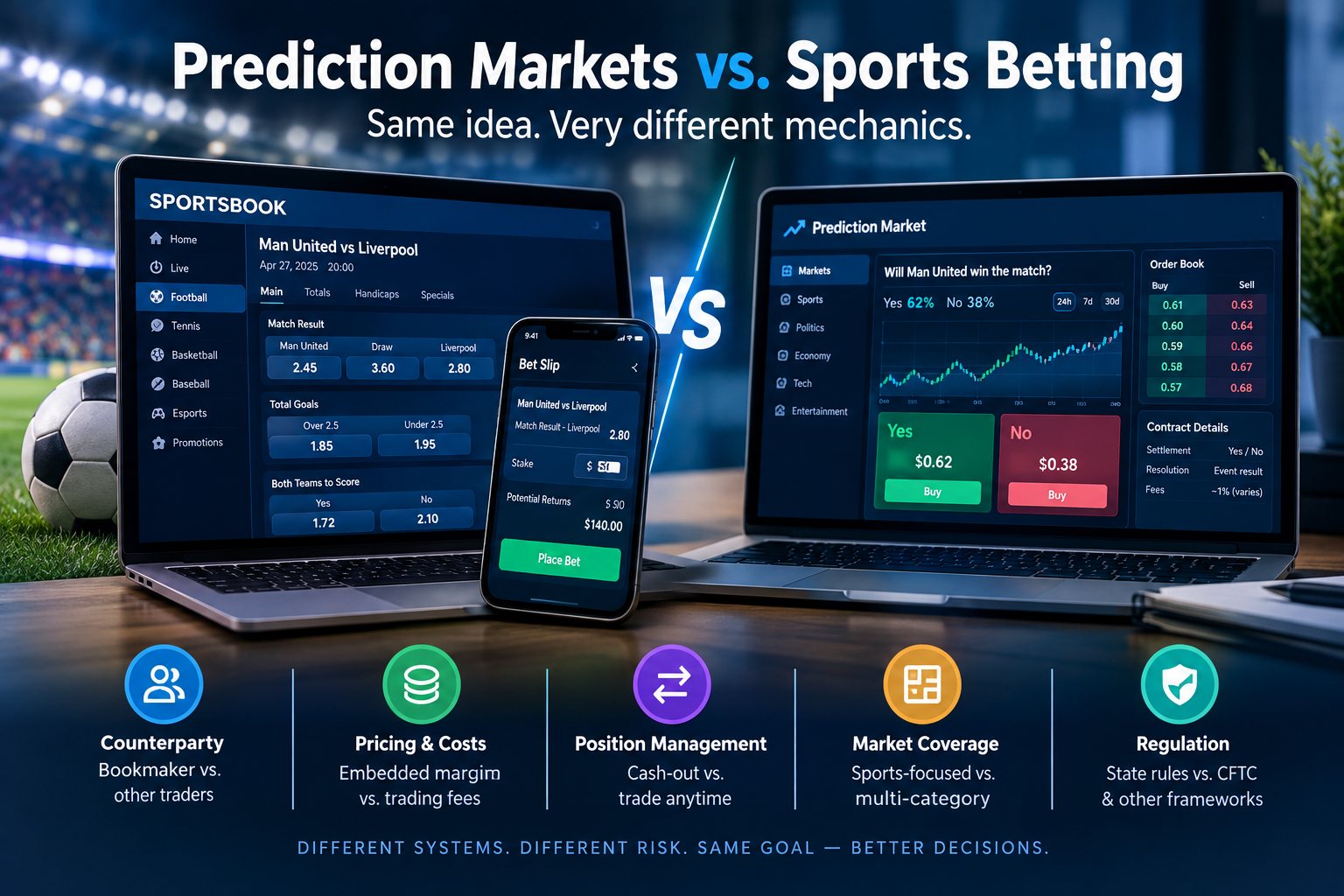
If you’ve ever had a winning streak on a traditional sportsbook, you probably know what happens next: your account gets flagged, your max bet suddenly drops to $2.14, or you get locked out entirely.
To most people, sports betting and prediction markets look like identical twins. You risk money on something that hasn’t happened yet, wait for the result, and collect your payout if you’re right.
But under the hood, the two couldn’t be more different. One is a casino-style game run by an operator determined to beat you; the other is a genuine financial exchange where people trade probabilities against each other.
If you’re trading capital, building a product, or just trying to figure out where the industry is heading, here is how the mechanics actually shake out.
1. Who Are You Actually Playing Against?
The biggest difference between the two models comes down to a simple question: Where does the payout money come from?
When you place a wager on a traditional sportsbook like FanDuel or BetMGM, you are betting against the house. The sportsbook is your direct counterparty.
If you hit a massive six-leg parlay, that money comes straight off their balance sheet. Because bookmakers take on direct risk with every dollar wagered, they have a massive incentive to run risk-management algorithms that sniff out profitable players.
The moment you beat their closing lines consistently, they cut your stakes or show you the door.
Prediction markets don’t care if you win.
Venues like Kalshi or the polymarket prediction market platform operate much more like modern financial exchanges. They use a Central Limit Order Book (CLOB) to match buyers and sellers directly:
- Every contract is binary, settling at either $1.00 (event happens) or $0.00 (it doesn’t).
- If a contract trades at $0.65, the market is pricing a 65% probability.
- You pay $0.65 for the “Yes” share, while someone else pays $0.35 for the “No” share.
- The winner takes the full $1.00 pool when the outcome is settled.
The exchange never takes balance-sheet risk on the outcome. It simply collects a tiny transaction fee (often under 1%) for matching orders.
In fact, prediction markets actively want sharp, profitable traders—because those traders bring liquidity, tighten spreads, and make the platform more reliable for everyone else.
2. The Hidden Tax: The Vig vs. Market Pricing
Most sports bettors have no idea how much money they bleed to the house edge, known as the “vig” or the juice.
Take a routine NFL spread where both teams have an equal shot at covering. A fair coin-flip should offer even money (+100 in American odds, or 2.00 in decimal). But sportsbooks price both sides at -110 (1.91).
To win $100, you have to risk $110. Do the math on both sides:
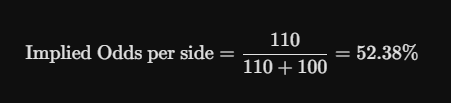
Add both sides together: $52.38\% + 52.38\% = 104.76\%$. That extra 4.76% is the bookmaker’s guaranteed edge over time. On complex futures bets (like picking the champion six months out) or multi-leg parlays, sportsbook hold rates often climb past 20% to 30%. You aren’t just trying to predict the future; you’re trying to outrun a steep structural penalty.
| Feature | Traditional Sports Betting | Prediction Markets |
| Counterparty | The House (Bookmaker) | Other traders (Peer-to-peer) |
| House Edge / Vig | 4.5% to 8% on singles, 20%+ on parlays | 0% house edge (pricing is pure probability) |
| Platform Revenue | Player losses + built-in margins | Tiny trading/clearing fees (typically 0% to 2%) |
| Trade Flexibility | Locked in until the game ends | Enter and exit anytime at live market prices |
| Early Cashout | Heavily discounted bookmaker buyout | Transparent sale back to the open order book |
| Treatment of Winners | Account limits, stake caps, bans | Welcomed (they provide critical liquidity) |
| US Regulation | State Gaming Commissions | CFTC (Commodity Futures Trading Commission) |
Prediction markets strip out the vig. If a contract is priced at $0.40, the implied odds are exactly 40%. There is no built-in overround skimming money off the top.
You pay an upfront, transparent trading fee instead of fighting against tilted odds. Over hundreds of trades, that difference alone is often the line between staying profitable or going broke.
3. Position Management: Are You Betting, or Are You Trading?
When you place a standard sports bet, you’re essentially locked in a room until the game ends.
Sure, sportsbooks have introduced the “Cash Out” button, but that’s rarely a fair deal. It’s an algorithmic buyout calculated to shortchange you on your equity.
If your team is up at halftime, the bookmaker might offer you a buyout that quietly strips away 15% to 20% of your real expected value.
Prediction markets work like an equity trading desk:
- Instant Liquidity: If you buy contracts at $0.20 on a political candidate or team, and sudden news bumps that price up to $0.55, you don’t have to wait for election night or the final whistle. You can hit the sell button, take your 175% profit, and move your capital elsewhere.
- Dynamic Stop-Losses: If a trade goes against you—say, an unexpected injury or an inflation report that misses expectations—you don’t have to sit there and eat a 100% loss. You can exit at $0.10 to save a chunk of your bankroll.
- Hedging Real-World Exposure: Because these markets behave like commodities, you can use them to offset real financial risks, like interest rate hikes, commodity swings, or currency drops.
This flexibility is why so many crypto-native traders and quantitative desks have gravitated toward platforms built on open order books.
If you look at how active volume moves across the polymarket prediction market platform, most participants aren’t treating it as a digital betting window.
They treat it as an open derivatives market, trading implied volatility and momentum rather than holding tickets to settlement.
4. What Can You Actually Trade?
Sportsbooks are naturally limited by the sports calendar. Their entire catalog revolves around athletic matchups: point spreads, player points, and total goals. It’s designed strictly for entertainment.
Prediction markets treat information as the asset.
Because prices represent real-time probability estimates backed by capital, they act as massive consensus engines. Economic research has shown for decades that open financial markets forecast real-world events far more accurately than surveys, pundits, or corporate focus groups.
On an exchange, you’ll find markets across nearly every domain:
- Macroeconomics: Where the Fed will set interest rates at the next FOMC meeting, monthly CPI prints, and non-farm payroll surprises.
- Geopolitics: Regulatory policy decisions, elections, treaty ratifications, and leadership changes.
- Culture and Tech: Breakthroughs in artificial intelligence, clinical trial verdicts from the FDA, and orbital launch dates for private aerospace companies.
- Sports: Game spreads, tournament outcomes, and championship futures—traded on an exchange rather than against a casino.
When major world events break, prediction market prices often adjust minutes before mainstream news agencies can publish a confirmation. Money moves fast when it’s chasing the truth.
5. The Regulatory Split: State Gaming vs. Federal Finance
The divide between these two models isn’t just theoretical—it is written into law.
In the United States, sports betting is regulated state by state.
Ever since the Supreme Court struck down PASPA in 2018, operators have had to navigate an expensive patchwork of state gaming commissions, distinct consumer restrictions, and steep gross gaming revenue (GGR) taxes that can climb as high as 51%.
Prediction markets operate under an entirely different legal umbrella.
Centralized US exchanges like Kalshi are classified as Designated Contract Markets (DCMs) and fall under the federal authority of the Commodity Futures Trading Commission (CFTC).
They don’t offer gambling games; they offer binary event contracts and financial derivatives under the Commodity Exchange Act. At the same time, decentralized protocols settle trades globally via smart contracts, bypassing local banking rails entirely.
This fundamental shift is why gaming operators, consumer fintechs, and media companies are rethinking their roadmaps.
Instead of building sportsbooks that require massive risk desks to balance books and limit sharp players, many companies are pivoting to an exchange model.
Launching a turnkey prediction market platform lets an operator generate dependable, volume-based revenue while eliminating balance-sheet liability and counterparty risk altogether.
Two Fundamentally Different Games
At the end of the day, sports betting and prediction markets simply cater to different mindsets.
If you’re kicking back on a Sunday afternoon and want to put $10 on a wild parlay for fun, the simplicity of a mobile sportsbook app is tough to beat. That product is built for quick entertainment, and it does that job well.
But if you want fair mathematical pricing, the ability to enter and exit positions whenever you want, and zero fear of being banned just because you know how to win, sportsbooks can’t compete.
Prediction markets strip away the bookmaker, replace the house edge with an open order book, and turn event forecasting into a real financial discipline.
That is precisely where specialized infrastructure providers like TRUEPREDiCT come into play. By delivering turnkey, white-label prediction market software, TRUEPREDiCT allows operators, consumer fintechs, and Web3 brands to roll out their own peer-to-peer trading platforms without spending two years and millions of dollars building an order-matching engine from scratch.

