

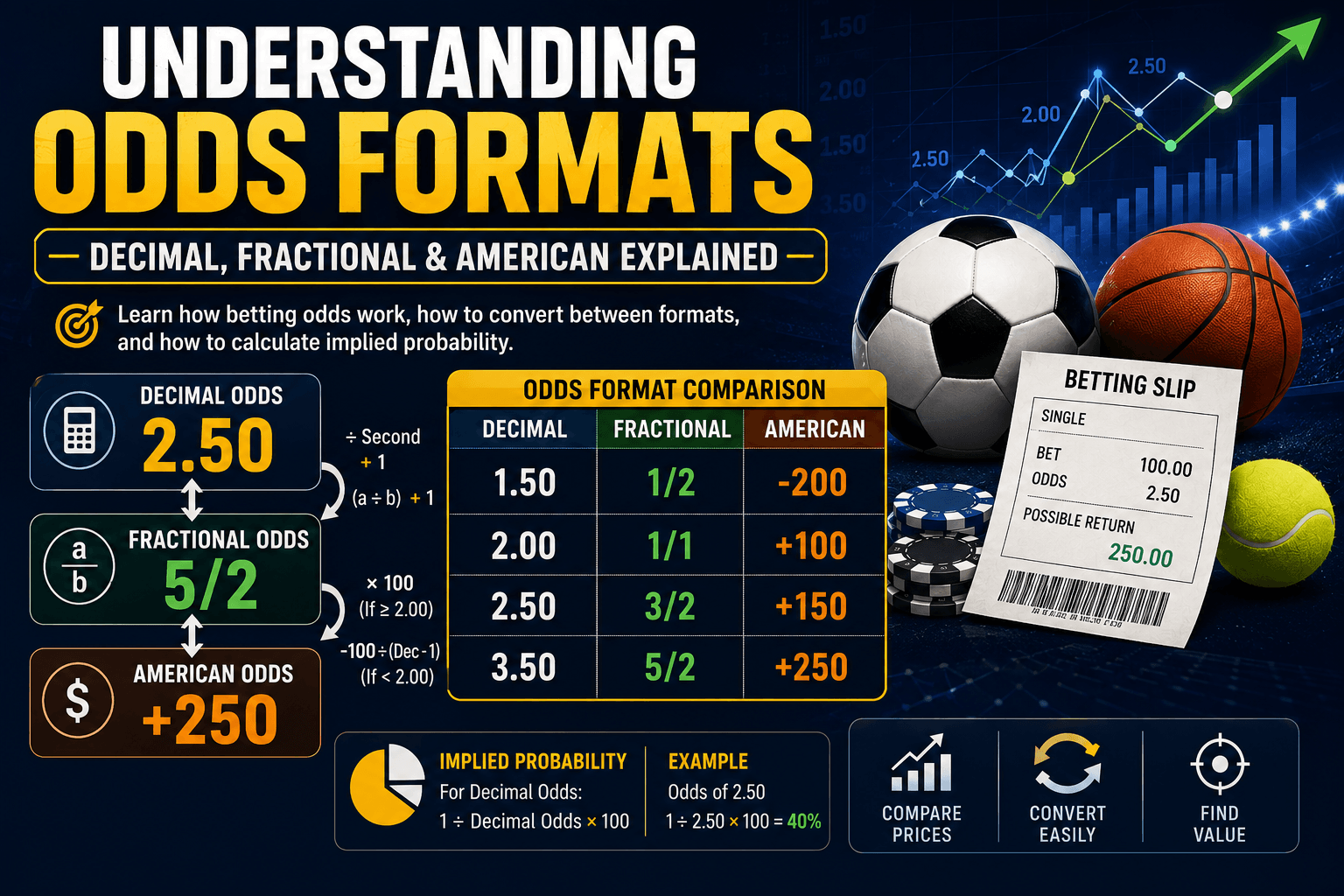
Understanding Odds Formats is essential for anyone involved in sports betting. Whether you encounter decimal, fractional or American odds, knowing how each format works can help you compare prices and identify value more effectively.
Odds are the language of sports betting, and like any language, they are much easier to use once you understand the grammar. The challenge is that there are three main formats in widespread use around the world, and if you switch between platforms or markets you will encounter all three. Understanding what each format is telling you, and how to convert between them, is one of the most practical skills any sports bettor can develop.
Decimal Odds: The Most Straightforward Format
Decimal odds are exactly what they sound like: a single number expressed as a decimal. If you see odds of 2.50 on a football match, that number represents your total return for every unit staked, including your original stake.
So if you place ten pounds on a team at 2.50 and they win, you receive twenty-five pounds back in total: your ten-pound stake plus fifteen pounds in profit. The calculation is always the same: stake multiplied by decimal odds equals total return.
Decimal odds are the most popular format in Europe, Australia, and Canada. Most online platforms default to decimal because the maths is clean and intuitive. They also make it very easy to identify which selection in a market is the favourite: the lower the decimal number, the shorter the price.
Fractional Odds: The Traditional British Format
Fractional odds are the format you will see at racecourses and traditional bookmakers in the UK and Ireland. They express your potential profit as a fraction of your stake, rather than your total return.
Odds of 5/2 mean that for every two units you stake, you stand to win five units in profit. So ten pounds at 5/2 returns twenty-five pounds in profit plus your ten-pound stake back, giving a total return of thirty-five pounds.
When the fraction is less than one, such as 1/2, the selection is described as odds-on. At 1/2, you need to stake two pounds to win one pound in profit. Odds-on selections are considered more likely to win than not according to the market.
Fractional odds can feel more complex than decimals once you move away from clean fractions. A price like 13/8 requires a bit more mental arithmetic than seeing 2.625 in decimal form.
American Odds: Moneyline Format Explained
American odds, also called moneyline odds, are the standard format in the United States and are expressed as either a positive or negative number. Once you understand the underlying logic, they become straightforward.
A positive number, such as +250, tells you how much profit you would make on a one hundred unit stake. At +250, a one hundred pound bet returns two hundred and fifty pounds in profit plus your stake.
A negative number, such as -200, tells you how much you need to stake to make one hundred units in profit. At -200, you need to stake two hundred pounds to win one hundred pounds in profit.
Negative moneyline odds indicate a favourite. The larger the negative number, the stronger the favourite. Positive numbers indicate an underdog, and the larger the positive number, the bigger the underdog.
Converting Between Formats
Being able to convert between formats is useful when you are comparing prices across different platforms. The maths is not complicated once you know the formulas.
To convert fractional to decimal, divide the first number by the second and add one. So 5/2 becomes (5 divided by 2) plus 1, which equals 3.50.
To convert decimal to fractional, subtract one from the decimal and express as a fraction. So 3.50 minus 1 equals 2.50, which as a fraction is 5/2.
To convert decimal to American: if the decimal is 2.00 or above, subtract 1 and multiply by 100 to get the positive moneyline. If below 2.00, divide negative 100 by (decimal minus 1) to get the negative moneyline.
Platforms like hititbet typically allow users to switch between formats in their account settings, so you can always display odds in whichever format you find most natural.
Implied Probability: What Odds Really Mean
Behind every set of odds is an implied probability: the market’s estimate of how likely an outcome is to occur. Converting odds to implied probability gives you a more intuitive way to think about value.
For decimal odds, the formula is simple: divide 1 by the decimal odds and multiply by 100. Odds of 2.50 imply a 40% probability. Odds of 1.50 imply a 66.7% probability.
The sum of implied probabilities across all outcomes in a market will always exceed 100%. That excess is the bookmaker’s margin, sometimes called the overround or the vig. Understanding this margin helps you evaluate whether the prices in a market are generous or tight.
Which Format Should You Use?
Use whichever format allows you to assess value most quickly and accurately. Most experienced bettors have a strong preference for one format that they have used for long enough that the numbers feel intuitive.
If you are just starting out, decimal odds are generally recommended because the maths is cleanest and comparison between selections is easiest. Once you are comfortable with decimals, understanding the other formats becomes considerably easier because you have a reference point to work from.
The format you choose does not affect the underlying value of the bet. A good price is a good price regardless of how it is expressed.

