

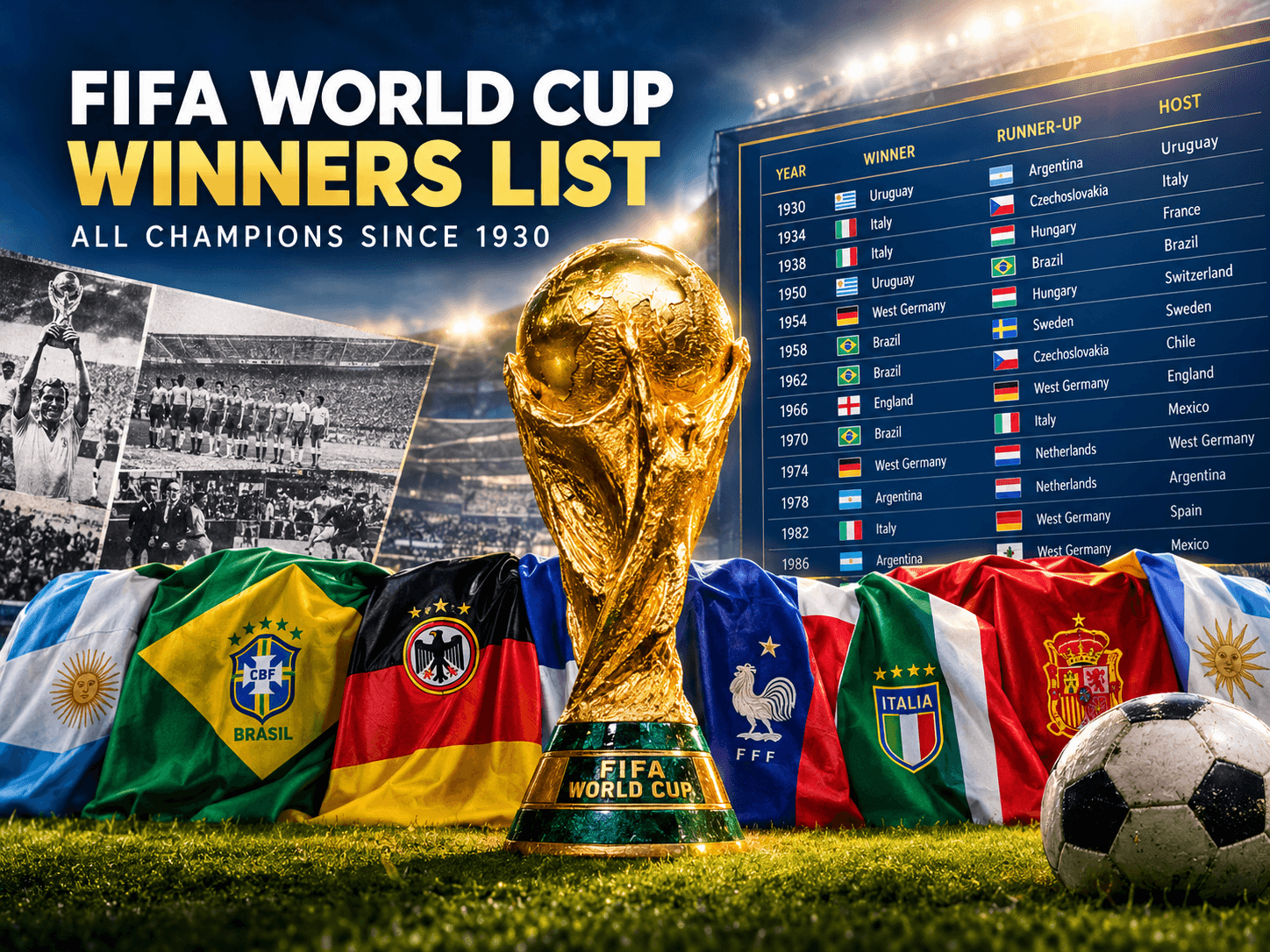
The FIFA World Cup has crowned the best national teams in men’s international football since its inaugural tournament in Uruguay in 1930. Over nearly a century, the competition has produced legendary champions, unforgettable finals and some of the sport’s most celebrated players.
Brazil remains the most successful nation with five titles, followed by Germany and Italy with four each. Argentina has won three championships, while Spain joined France and Uruguay on two titles after defeating Argentina in the 2026 final.
This complete FIFA World Cup winners list covers all 23 tournaments played between 1930 and 2026, including the champions, runners-up, host countries and final results.
Complete FIFA World Cup Winners List From 1930 to 2026
The FIFA World Cup has generally taken place every four years since 1930. The only interruptions occurred in 1942 and 1946, when the competition was cancelled because of World War II.
The following world cup winners list includes every completed tournament, with the host nation and the result that determined the championship.
- 1930 — Uruguay: Hosted by Uruguay. Defeated Argentina 4-2.
- 1934 — Italy: Hosted by Italy. Defeated Czechoslovakia 2-1 after extra time.
- 1938 — Italy: Hosted by France. Defeated Hungary 4-2.
- 1950 — Uruguay: Hosted by Brazil. Defeated Brazil 2-1 in the decisive final-round match.
- 1954 — West Germany: Hosted by Switzerland. Defeated Hungary 3-2.
- 1958 — Brazil: Hosted by Sweden. Defeated Sweden 5-2.
- 1962 — Brazil: Hosted by Chile. Defeated Czechoslovakia 3-1.
- 1966 — England: Hosted by England. Defeated West Germany 4-2 after extra time.
- 1970 — Brazil: Hosted by Mexico. Defeated Italy 4-1.
- 1974 — West Germany: Hosted by West Germany. Defeated the Netherlands 2-1.
- 1978 — Argentina: Hosted by Argentina. Defeated the Netherlands 3-1 after extra time.
- 1982 — Italy: Hosted by Spain. Defeated West Germany 3-1.
- 1986 — Argentina: Hosted by Mexico. Defeated West Germany 3-2.
- 1990 — West Germany: Hosted by Italy. Defeated Argentina 1-0.
- 1994 — Brazil: Hosted by the United States. Drew 0-0 with Italy and won 3-2 on penalties.
- 1998 — France: Hosted by France. Defeated Brazil 3-0.
- 2002 — Brazil: Hosted by South Korea and Japan. Defeated Germany 2-0.
- 2006 — Italy: Hosted by Germany. Drew 1-1 with France and won 5-3 on penalties.
- 2010 — Spain: Hosted by South Africa. Defeated the Netherlands 1-0 after extra time.
- 2014 — Germany: Hosted by Brazil. Defeated Argentina 1-0 after extra time.
- 2018 — France: Hosted by Russia. Defeated Croatia 4-2.
- 2022 — Argentina: Hosted by Qatar. Drew 3-3 with France and won 4-2 on penalties.
- 2026 — Spain: Hosted by Canada, Mexico and the United States. Defeated Argentina 1-0 after extra time.
The 1950 World Cup was unusual because it did not feature a conventional knockout final. Instead, four teams competed in a final round-robin group. Uruguay’s victory over Brazil in the last match determined the champion.
The 2026 tournament introduced another major change, expanding the competition to 48 national teams and 104 matches.
Which Country Has Won the Most FIFA World Cups?
Brazil leads the all-time ranking with five championships. Its victories came in 1958, 1962, 1970, 1994 and 2002, covering several generations of outstanding players.
Germany and Italy follow with four titles each, while Argentina has three. Spain’s victory in 2026 brought its total to two championships.
The complete ranking of World Cup winners by number of titles is:
- Brazil — 5 titles: 1958, 1962, 1970, 1994, 2002.
- Germany — 4 titles: 1954, 1974, 1990, 2014.
- Italy — 4 titles: 1934, 1938, 1982, 2006.
- Argentina — 3 titles: 1978, 1986, 2022.
- Spain — 2 titles: 2010, 2026.
- France — 2 titles: 1998, 2018.
- Uruguay — 2 titles: 1930, 1950.
- England — 1 title: 1966.
Germany’s total includes the three championships won by West Germany before reunification.
Only European and South American national teams have won the men’s FIFA World Cup. European countries account for 13 championships, while South American nations have collected 10.
Historical World Cup results can reveal patterns in international football, although previous success does not guarantee future victories. Team form, squad strength, scoring records and defensive performance can all contribute to a mathematical prediction of a match, offering a statistical perspective alongside traditional football analysis.
The First World Cup Champions and Brazil’s Golden Era
Uruguay became the first World Cup champion in 1930, defeating Argentina 4-2 in Montevideo. The victory confirmed the country’s position among the strongest international teams of the period.
Italy then became the first nation to win consecutive World Cups. Under coach Vittorio Pozzo, the Italians claimed the 1934 title on home soil before successfully defending it in France four years later.
World War II interrupted the tournament, preventing the scheduled editions in 1942 and 1946 from taking place.
When the competition returned in 1950, Uruguay secured its second championship in one of football’s most famous matches. Brazil needed only a draw in the decisive final-round encounter at the Maracanã, but Uruguay came from behind to win 2-1. The result became known as the Maracanazo.
West Germany won its first title in 1954, overturning a two-goal deficit against Hungary to win 3-2 in a match remembered as the Miracle of Bern.
Brazil’s first championship followed in 1958. A 17-year-old Pelé scored twice in the 5-2 final victory over Sweden, announcing himself as one of international football’s greatest talents.
Brazil retained the trophy in 1962, with Garrincha playing a central role after Pelé suffered an injury during the tournament.
England claimed its first and only title in 1966, defeating West Germany 4-2 after extra time at Wembley. Geoff Hurst scored three goals in the final.
Four years later, Brazil produced one of the most celebrated World Cup campaigns in history. The team featuring Pelé, Jairzinho, Tostão and Carlos Alberto defeated Italy 4-1 in the 1970 final to secure its third championship.
West Germany won the 1974 tournament at home, beating the Netherlands 2-1 with Franz Beckenbauer as captain. Argentina followed in 1978, claiming its first title after defeating the Netherlands 3-1 in extra time.
By the end of the 1970s, the World Cup had already established several of its most successful national teams and enduring rivalries.
World Cup Winners From 1982 to 2002
The 1982 World Cup in Spain marked Italy’s return to the top of international football.
Paolo Rossi played a decisive role in the championship campaign, scoring six goals during the tournament. Italy defeated West Germany 3-1 in the final to claim its third title.
Argentina’s second championship arrived in 1986, largely inspired by Diego Maradona. His performances against England and Belgium helped Argentina reach the final, where the team defeated West Germany 3-2.
West Germany responded by winning the 1990 tournament in Italy. Andreas Brehme scored a late penalty against Argentina, securing a 1-0 victory and the country’s third World Cup title.
Brazil returned to the top in 1994 after defeating Italy in the first World Cup final decided by a penalty shootout. The match finished 0-0 after extra time before Brazil won 3-2 on penalties.
France became a first-time champion in 1998, defeating Brazil 3-0 in Paris. Zinedine Zidane scored twice in the final, helping the host nation achieve its greatest international success at that point.
The 2002 tournament brought Brazil’s fifth championship. Ronaldo scored both goals in the 2-0 final victory over Germany and finished as the competition’s leading scorer with eight goals.
Brazil has remained the most successful nation in World Cup history since that victory.
World Cup Winners From 2006 to 2022
European national teams dominated the next four World Cups, winning every tournament between 2006 and 2018.
Italy claimed its fourth title in 2006, defeating France on penalties after a 1-1 draw. The final was also remembered for Zinedine Zidane’s dismissal during extra time.
Spain won its first World Cup in 2010, completing a period of international success built around technical midfield play and possession-based football.
Andrés Iniesta scored the winning goal against the Netherlands in extra time, securing a 1-0 victory in Johannesburg.
Germany became champion in 2014 after Mario Götze scored the decisive goal against Argentina in extra time. The campaign also included Germany’s historic 7-1 semi-final victory over host nation Brazil.
France won its second title in 2018, defeating Croatia 4-2 in Moscow. Kylian Mbappé emerged as one of the tournament’s standout players, contributing to a team that combined attacking speed with defensive organisation.
Argentina ended the sequence of European champions at the 2022 World Cup in Qatar.
Led by Lionel Messi, Argentina reached the final against defending champions France. The match finished 3-3 after extra time, with Messi scoring twice and Mbappé completing a hat-trick.
Argentina won the penalty shootout 4-2, securing its third championship and giving Messi the World Cup title that had previously eluded him.
The victory marked South America’s first World Cup triumph since Brazil in 2002. Four years later, Spain brought the trophy back to Europe.
Spain Wins the 2026 FIFA World Cup
Spain became the latest addition to the fifa world cup winners list after winning the 2026 tournament in North America.
The competition was jointly hosted by Canada, Mexico and the United States, becoming the first men’s World Cup to feature 48 national teams.
Spain reached the final against defending champions Argentina, with the championship match taking place on 19 July 2026 at New York New Jersey Stadium.
Neither team scored during regulation time. The decisive moment came in the 106th minute, when Ferran Torres found the net to give Spain a 1-0 victory after extra time.
The result secured Spain’s second World Cup title, 16 years after Andrés Iniesta’s winning goal against the Netherlands in 2010.
Spain also became the first country to hold the men’s and women’s FIFA World Cup titles simultaneously, following the women’s national team’s victory in 2023.
The 2026 championship marked an important achievement for a new generation of Spanish players. Rodri received the tournament’s Golden Ball, while goalkeeper Unai Simón won the Golden Glove after keeping seven clean sheets in eight matches.
Spain’s triumph also prevented Argentina from becoming the first nation since Brazil in 1962 to successfully defend the men’s World Cup title.

