

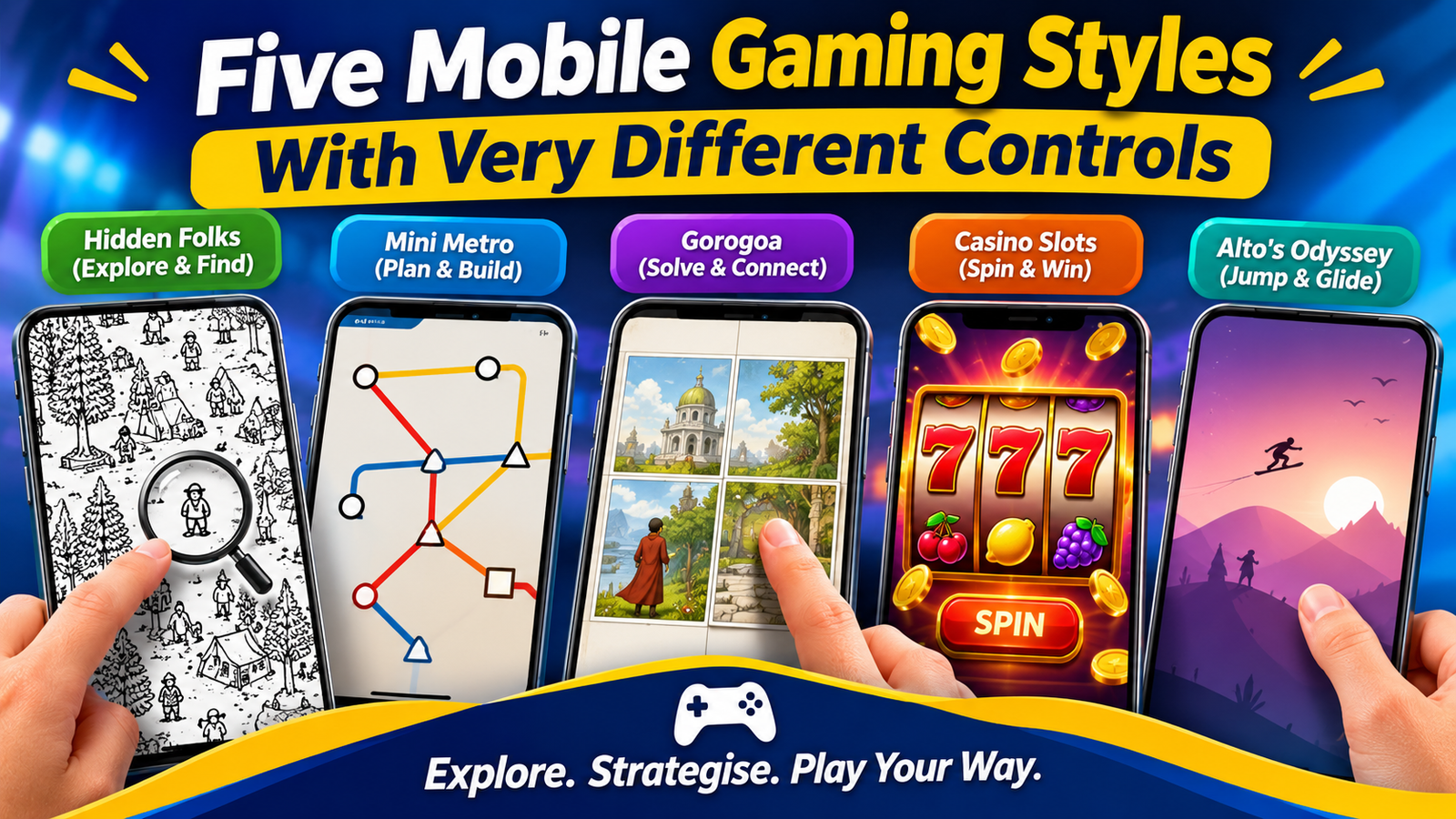
In Hidden Folks, even the tents are worth investigating. Some hide the people on the search list; others just open with a ridiculous noise. It’s easy to waste time checking them all.
Mini Metro offers considerably less room for wandering attention. A railway line might be working nicely, but new stations keep appearing whether the existing passengers are happy or not. Gorogoa is still a stranger still: sometimes solving a puzzle means taking a picture apart.
These are quite different ways of using a phone. And appearances can be deceptive, particularly when two games use similar symbols. The slots found through bizbet casino, for example, may resemble matching puzzles without giving players the same control over the result.
What matters isn’t only what appears on the screen. It’s what happens when someone touches it.
1. Hidden Folks Has a Very Noisy Forest
Hidden Folks gives you a checklist and an enormous drawing to search. Some names on the list are easy enough to match with something in the picture. Others send you poking around places that don’t look particularly promising.
You might spend ages checking the trees while the missing character is somewhere near a group of tents. And even when you find the right area, there’s no guarantee the person you’re looking for is actually visible yet.
Then there are the noises. A tent opens with a silly little sound, a bush rustles, and another object makes a noise that sounds like somebody fooling around with a microphone. The effects were made using human voices, which suits the hand-drawn artwork rather well.
Finding an object sometimes means touching something else first.
A phone makes the larger drawings rather demanding. It’s possible to spend several minutes examining a small patch of forest, only to realise the target was somewhere outside the area being viewed. Zooming out gives a better sense of the scene, at the expense of the tiny details.
There is plenty of amusement in that process. Sometimes an object isn’t the one being searched for at all, but tapping it produces such a strange noise that it’s worth doing anyway.
2. Mini Metro Punishes a Perfectly Good Drawing
There is something satisfying about the first railway line in Mini Metro.
Two stations, a coloured connection and a train. Everything runs without complaint.
The trouble arrives later. A third station needs connecting, then another appears on the opposite side of the river. Passengers start waiting at stations that once seemed perfectly placed.
A line that served three stations comfortably can become overloaded after several new stops are added. The obvious solution might be another train, except there aren’t always enough available.
The Mini Metro developer’s website describes the central task: building and adjusting railway routes as new stations appear.
Drawing those routes is the easy bit. Deciding when to abandon an earlier arrangement takes more thought. A station collecting too many passengers may need a direct connection, but changing an existing line can leave another station poorly served.
The game rarely feels frantic at first. The trains move along their coloured routes, little passenger symbols accumulate, and there’s time to consider the next adjustment.
Then the waiting crowds grow too large, and the railway that seemed perfectly adequate a moment ago is finished.
3. Gorogoa Won’t Stay Inside Its Pictures
Gorogoa has a board divided into four spaces, each capable of holding an illustration. That’s nearly everything the player gets to work with. The rest has to be discovered by moving pictures around and examining what’s inside them.
At first, the panels seem to contain unrelated scenes. A building in one picture might be viewed from a completely different distance in another. Move the right panel, though, and the two views can become part of the same route.
Not every panel has to remain intact, either. Parts of the drawings can be separated, uncovering another scene to work with.
It’s an unusual idea, and Gorogoa doesn’t spend much time explaining it. The early puzzles give players an opportunity to discover what can be moved and what cannot.
The artwork is worth studying even when progress has stalled. Jason Roberts filled the illustrations with details that are easy to pass over on the first look.
The phone version has its awkward moments. Working with four panels means each drawing gets only a portion of the display. A detail that looked unimportant while enlarged may be difficult to recognise when the whole board is visible.
Some puzzles take repeated attempts before the arrangement makes sense. Others are solved almost accidentally, when a panel is moved into a position that hadn’t seemed promising.
4. Casino Reels Leave the Symbols to Chance
The first three games give players different kinds of control. Hidden Folks allows them to investigate objects, Mini Metro lets them alter routes, and Gorogoa involves arranging illustrations.
Casino slots may look familiar on the surface, but the player’s role is different.
Fruit symbols appear in plenty of mobile games. So do coloured stones and sweets. But the presence of familiar pictures says very little about the decisions a player can make.
In a matching puzzle, choosing the wrong pair of tiles can leave the board in a difficult position. The next move depends partly on what was moved before.
A slot works on another principle. Its symbols may occupy a similar grid, but the player isn’t choosing combinations by shifting individual pieces around.
The difference becomes more obvious once money enters the picture.
A puzzle can usually be restarted after an unsuccessful attempt. A completed casino wager has a recorded financial outcome, which may be a loss.
Card games aren’t all alike either. Building a deck in a strategy title involves different decisions from placing a wager in a casino card game.
There’s also more information to keep track of during real-money play. The amount selected for a round shouldn’t be confused with the available balance or a possible payout.
Language matters when reading those details. The Bizbet Монгол page provides a different language version of the site, while individual casino titles have their own instructions and payout information.
Before playing, the relevant details to locate include:
- The amount being staked.
- The rules for the chosen game.
- The available balance.
- The record of completed rounds.
Those details deserve attention even when the game graphics take up most of the phone screen.
5. Alto’s Odyssey Barely Needs a Button
After the symbols and menus of casino games, Alto’s Odyssey offers a different kind of simplicity. There’s very little to manage on the screen beyond the next jump.
Alto travels across the sand without requiring the player to steer. Most of the input comes down to a single finger.
The first few runs are enough to explain the controls. Tap for a jump, keep pressing for a backflip, then release before the character reaches the ground.
It sounds easy until the dunes begin arriving at inconvenient intervals.
There may be enough height to attempt a trick but not enough time to finish it. A rock can also appear just beyond a landing, leaving almost no opportunity to prepare the next jump.
An unfinished backflip sends Alto straight into the sand. A jump made a moment too late can end at the next rock instead.
Most of the time, the thumb has very little to do. The hard part is watching the ground ahead and deciding whether there’s room for another trick.
The simplicity also suits shorter sessions. It doesn’t take several minutes to remember how everything works after returning to the game.
Different Games, Different Reasons to Tap
The most noticeable thing about this selection is how little the controls have in common.
Hidden Folks can occupy someone with a single crowded drawing for ages. Mini Metro gives players a railway network that gradually becomes harder to keep running.
Gorogoa is a matter of moving pictures until an unexpected connection appears. Alto’s Odyssey gives the player rather less time to think, particularly with another rock approaching.
The casino section works differently. Choosing a stake doesn’t give the player control over the symbols that appear or the result of the round. That result can involve losing money, unlike an unsuccessful attempt at a conventional puzzle.
A screenshot of these games can tell you what the artwork looks like. It says rather less about the decisions you’ll actually be making with your fingers.

