

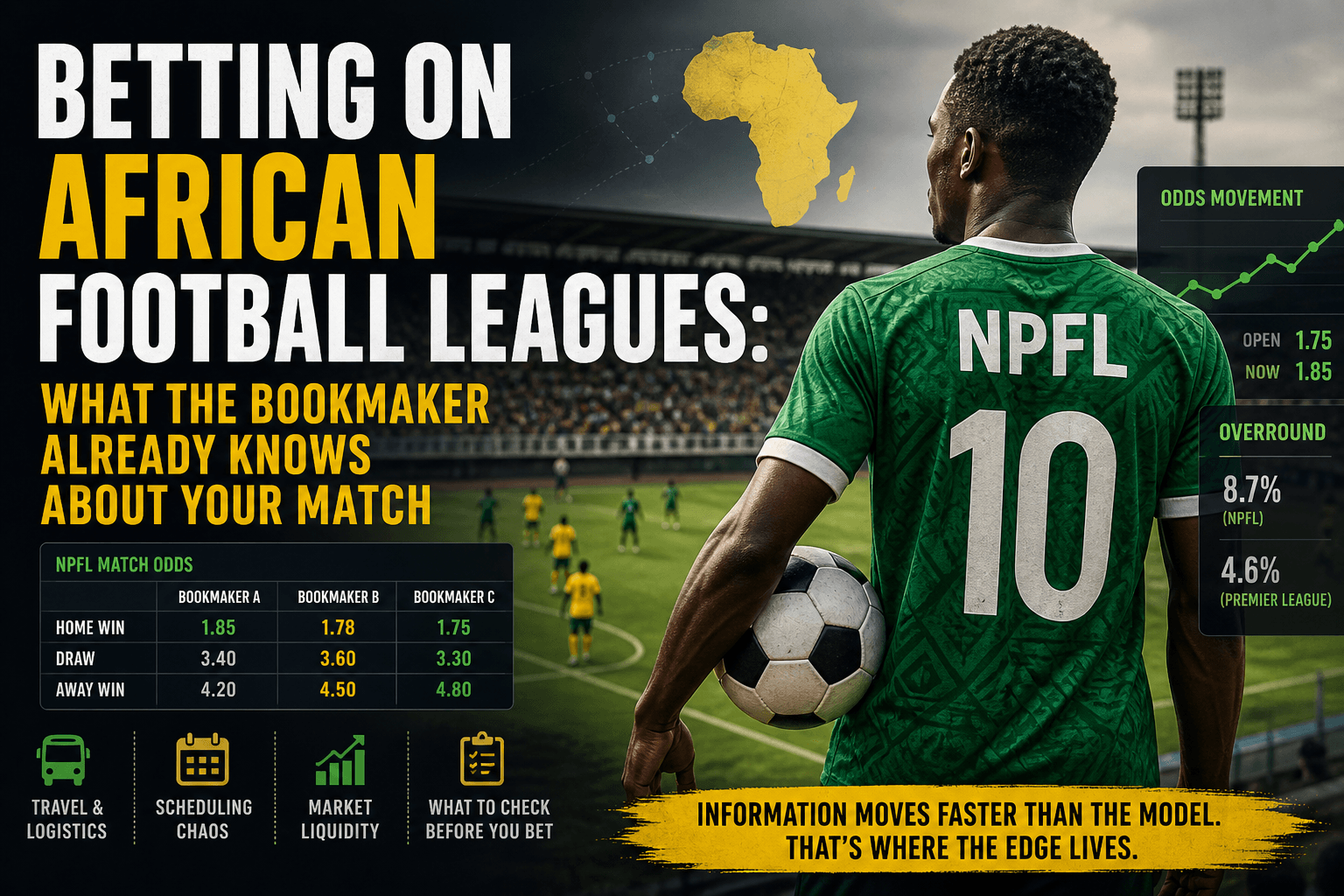
Tunde lives in Lagos. He bets most weekends — mostly NPFL because that’s the football he watches, and Premier League because everyone bets on Premier League. Three years in, he’s still looking for a “trick” to NPFL: the league should be easier to read because he understands the local context. He leans on home favorites, picks the obvious teams, cashes some, loses more, and can’t quite work out why his edge isn’t bigger.
The answer is uncomfortable: every “edge” Tunde thinks he has, the bookmaker has too. Travel logistics, home-team bias, low-scoring league — already in the price he’s clicking. Bookmakers run entire teams pricing African leagues, well enough that the obvious local-knowledge plays are already eaten by the lines. The lines aren’t softer. They’re built on a different terrain.
A lot of bettors in Tunde’s position search for “100% sure predictions” or a “prediction site that never loses.” What they actually want is consistency — not certainty. A process that doesn’t blow up the bankroll over a season. Bettors who finish the year ahead aren’t the ones who found a magic site; they understood the markets they bet into.
This piece is about that terrain — what changes when you bet on NPFL, the FKF Premier League in Kenya, or the NBC Premier League in Tanzania, and where the actual mispricings live. For bettors comparing prices across operators, aggregators like Odds by TipsGG help here precisely because African leagues trade on far thinner liquidity than European top flights, and price spreads between books are wider than most people assume.
Home Advantage Is Real, But Not What Tunde Thinks
The most-cited “fact” about NPFL betting: home teams win an outsized share of matches. NPFL home win rates have historically sat in the 65–75% range depending on the season, against roughly 40–47% in the English Premier League. Kenyan and Tanzanian top-flight numbers run in a similar elevated range. Reasons are well-documented: travel logistics (NPFL clubs almost never charter flights, bus journeys of 8 to 15+ hours routine), climate (northern Nigerian fixtures in 30°C+ heat versus coastal-climate visitors; Nairobi at ~1,795 m altitude), and home-favorable refereeing pressure shown to be statistically detectable in academic work.
Where Tunde gets it wrong: bookmakers see the same data. A team that wins 70% of home fixtures is priced near 70% implied probability, with margin layered on top. The home favorite at 1.50 isn’t a “trick” the bookmaker missed — it’s exactly what the bookmaker calculated. Tunde gets a near-fair price on a likely outcome. He doesn’t get an edge.
The Handicap Trap
Tunde sees the home favorite at 1.50 and thinks: too low. So he climbs the handicap ladder for a bigger payout — Asian handicap −1 at 1.85, −1.5 at 2.30, maybe a correct score punt. This feels like outsmarting the price. It isn’t.
Handicap and total markets are derivatives of the 1X2 market: bookmakers price them from the same probability distribution they used to set the moneyline, then layer the same margin on top. If the home win is fairly priced, the −1 handicap is too. What changes is variance, not edge — the payout is bigger because the win condition is harder, in roughly the proportion the bookmaker calculated. Tunde isn’t paying less for the same probability; he’s paying the same overround on a noisier outcome. Correct score and BTTS combos usually carry an even higher overround on top.
What this means for a bettor: if the headline market on a fixture is fairly priced, the side markets are too. Switching markets isn’t a strategy. Edge comes from finding information the model didn’t have — when something specific moves faster than the model: a recently rescheduled fixture, a key player missing from a regional source, a midweek match after a particularly grueling away trip.
Scheduling Chaos Creates Information Asymmetry
European top-flight calendars are stable. African league calendars frequently are not. Fixture postponements, security-related cancellations, venue changes, and referee reassignments hours before kickoff are documented features of NPFL and several other African top flights. The Confederation of African Football (CAF) periodically intervenes, and league-level governance disputes have repeatedly disrupted schedules. A local fan often knows a fixture has been quietly moved or that a key player is unavailable hours before international price feeds reflect it. Books respond by tightening limits and widening margins — overround on these markets at international operators frequently sits in the 7–10% range versus 4–5% on Premier League sides.
What this means for a bettor: the difference between an informed and an uninformed bettor is rarely about predictions; it’s about which sources the bettor reads before placing the stake.
Liquidity Tells You Where the Real Edge Lives
Liquidity — the volume of money flowing through a market — is a rough proxy for how confident bookmakers are in their pricing. NPFL, the FKF Premier League, and the NBC Premier League all trade on sharply lower liquidity than European top flights. Major sharp-focused books either don’t price these leagues or hold limits at a fraction of what they accept on Premier League fixtures. Lower liquidity does not mean softer lines. It means three practical things: larger price spreads between operators (the same NPFL match can show 1.85 at one local operator and 1.75 at another), stake limits that can be too low for a meaningful bankroll, and noisier closing-line movement.
What this means for a bettor: when Tunde clicks the first price he sees, he’s leaving money on the table. Same match, same stake, different book — the difference compounds. Our today’s predictions page covers daily fixtures across multiple African and European leagues.
Today’s African Football Predictions: What to Check First
Bookmakers are slow where information moves faster than their models. That’s the whole edge — late team news, reschedules, venue swaps, travel circumstances generic models don’t capture, last-minute referee changes. Most bets are lost before kickoff, at the moment you accept a bad price or outdated information. The practical checklist before placing any NPFL, KPL, or NBC Premier League stake:
- Squad news in regional sources. Punch, Goal Nigeria, Daily Nation Kenya, The Citizen Tanzania — local outlets often have lineup-affecting news hours before international feeds catch up.
- Fixture status. Has the match been rescheduled, moved venue, or had its kickoff time changed in the last 48 hours? If so, the line you see may be priced on stale conditions.
- Travel context. Is the away side coming off a long bus journey or a midweek fixture?
- Price comparison across operators. Same match, same stake — check three books. Spreads of five to ten percent between local operators on NPFL fixtures are routine.
- Stake limits. A line that closes at limits too low to matter isn’t a usable price.
Strip out the “100% sure” mythology and what’s left is the same set of disciplines that work in any market: bet flat or fractional (1–2% per stake survives variance), and track the bet itself, not the outcome. The leagues bookmakers price least efficiently are also the ones where information friction and liquidity costs eat deepest. Tunde gets ahead by working with that, not by hunting the shortcut that doesn’t exist.

