

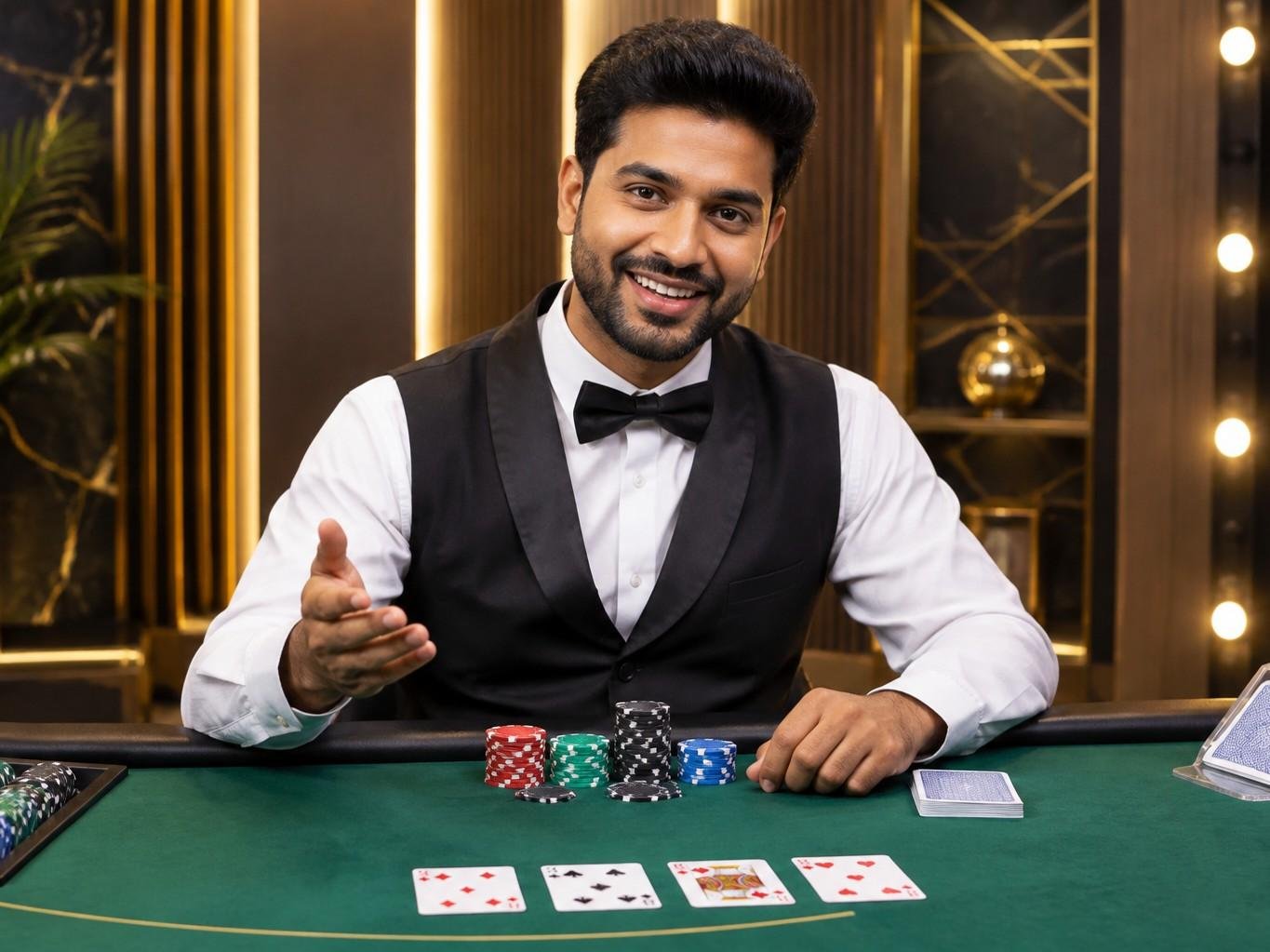
Watch any live format for long enough and you start noticing what promotional stills leave out. The set gleams, yet some sessions feel flat while others feel sociable. The difference usually sits with the person running the show: a host is what gives a video feed its human character.
That human layer is easy to overlook, whether you are watching a TV quiz, a streamed game show or one of the dealer tables that make up the desi live casino india scene.
A host’s timing, explanations and responses to viewers deserve as much attention as the studio lighting. Studio polish gets you to click; the voice is why you stay.
A casino table that doubles as a television studio
A live casino studio looks like a casino but works like a broadcast facility. Purpose-built floors hold real wheels, real cards and real croupiers, arranged for camera angles and stream quality as much as for players.
Several HD feeds cover each table – a wide shot of the layout, a close-up on the cards or wheel, a steady frame on the dealer’s face. In some games you can choose which camera to watch.
Those camera choices matter more than they sound. Everything the host does is staged for a screen you might be holding in one hand on a commute.
Where a random-number game only has to render an outcome, a live table has to show its work – shuffle, spin, reveal – and the host is who makes that proof legible in a window the size of a postcard.
Broadcasters first, card handlers second
The obvious assumption is that a great dealer makes a great host. Watch long enough and you’ll notice the best live dealer hosts work more like weather presenters who happen to deal cards.
The camera work keeps their hands in frame so viewers can see every move. Clear narration then gives a second way to follow the action when the picture is small or hard to make out.
There’s a hospitality layer too. Good hosts greet regulars by name, answer chat without letting the round drift, and keep an even tone after a notable result, so the room doesn’t lurch from celebration into silence.
As with a news presenter, a host’s composure matters most when something interrupts the broadcast: a frozen feed, a fumbled card or a chat that turns impatient.
How different formats test live dealer hosts
Not every format asks the same thing of the person behind the table. Card games lean on precision, wheels on ritual, game-show wheels on performance.
| Format | Host’s focus | What to watch |
| Card tables | Handling cards and explaining the sequence | Clear narration and visible card handling |
| Roulette tables | Guiding viewers through the wheel sequence | Callouts that are easy to follow |
| Game-show-style formats | Combining presentation with explanation | Energy that leaves room for clear instructions |
In game-show-style formats, the interesting question is whether the host can carry the spectacle without letting the explanation disappear. Spectacle works best when the presenter keeps the sequence easy to follow.
The pause that keeps a round together
A live table combines a person’s presentation with the timing of a broadcast and an on-screen interface. The host gives the round an audible rhythm, explaining its transitions while the game system manages the on-screen betting window.
A deliberate beat before a reveal gives viewers time to absorb the explanation and anticipate what comes next, the same trick quiz-show hosts have used for decades.
Spoken cues do similar work. Familiar callouts such as “place your bets” and “no more bets” help viewers follow the sequence, provided the audio stays clear.
The voice explains the action while the on-screen interface shows the timing. When the ball is still spinning after the window has closed, that is an ordinary part of the roulette sequence, and the host’s callout is what makes the transition easy to understand.
Reading the round when your network wobbles
A mobile connection can become uneven on a train, making a clear voice and an easy-to-follow sequence especially useful. On such a connection the real skill isn’t a faster phone – it’s reading the table through the noise.
- Listen for clear explanations. If the audio stays intelligible while the picture breaks up, the callouts help you follow the sequence.
- Watch the hands, not just the wheel. Good camera framing lets you follow the card handling without guessing what happened out of shot.
- Notice how pauses are handled. A clear explanation when the broadcast resumes is more useful than trying to read the connection from the host’s timing.
- Listen for a recap after a freeze. When the feed returns, a good host makes the missed action understandable.
Trust the pattern of agreement. When the audio, visible action and interface agree, the sequence becomes easier to follow again.
If they keep disagreeing, stop playing and simply watch. Sitting out a round is a sensible way to reset.
What a skilled host looks like from the player’s side
None of this shows up in a lobby thumbnail. It shows up after watching closely, which is exactly why the time is worth spending. The signs are unglamorous but consistent:
- Hands and cards stay in frame, giving the viewer a clear look at the action.
- The tempo between rounds holds steady, with no rushing after a notable result and no dragging through a quiet stretch.
- Mistakes are acknowledged openly, and the host explains the correction the game’s rules require.
- Chat gets a name read out and a quick answer, then the round moves on.
- Rule variations get one clear sentence instead of a memorised legal paragraph.
If there is a single signal to watch, it is the recovery. Anyone can look composed while the cameras behave; the craft shows when a broadcast is interrupted.
The caveat: even a superb host can’t rescue a dead connection. What a good host buys you is clarity about what just happened, and that’s worth more than studio gloss.
What stays human in the stream
So the opening observation holds: the glass, the lights and the cameras are the invitation, but the voice is the evening. Live dealer hosts turn a physical table into a broadcast, and a broadcast back into a table, building the ordinary kind of trust – visible shuffles, steady pacing, callouts you can follow with your eyes half-closed.
Treat live tables as structured entertainment with a limit you set before you sit down, and the host’s craft is easier to enjoy for what it is: the human factor that makes a stream feel like a room.

