

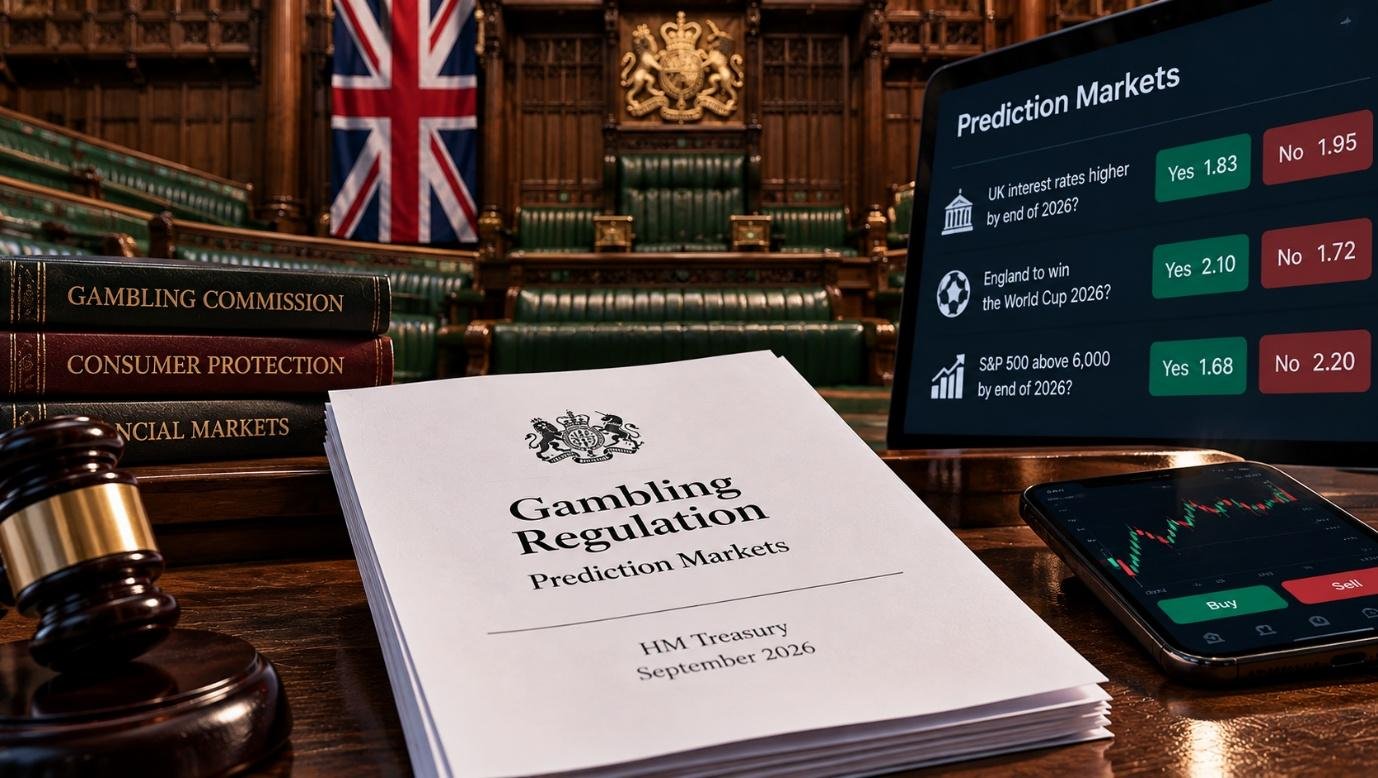
The UK government has clarified how prediction markets will be treated under British law, confirming that platforms offering these products in Great Britain would need a gambling licence rather than operating outside the existing betting framework.
The position was set out on September 8 in a parliamentary response from HM Treasury. Prediction markets allow users to trade or wager on whether real-world events will happen, often using prices that change as participants buy and sell positions.
Their rapid growth has created regulatory questions, particularly where the products resemble both financial trading and conventional betting.
Prediction Markets Fall Under Existing Gambling Law
The government said any prediction market wishing to operate in Great Britain would require approval from the Gambling Commission, the independent body responsible for regulating commercial gambling.
SBC News reported during the latest UK regulatory debate that prediction markets covering politics and sports would need to operate under a betting-intermediary licence from the Gambling Commission, while financial prediction products can also fall under rules overseen by the Financial Conduct Authority.
A betting intermediary provides a system through which users can enter betting transactions with one another rather than necessarily taking the opposite side of a customer’s wager.
That is why prediction markets can fall into a different licensing category from a conventional sportsbook while remaining inside gambling regulation.
The government has said it will continue monitoring their impact and consider further measures if required.
Why the Classification Matters
The decision removes some of the ambiguity around whether prediction markets could be treated primarily as financial products in Britain.
A prediction contract may display a price that moves depending on the perceived probability of an event occurring, making the interface resemble a trading platform.
From the regulator’s perspective, however, appearance is less important than what the transaction actually does. If participants are effectively staking money on an uncertain event, gambling legislation can apply even when the product uses terminology associated with financial markets.
Britain Already Has a Regulatory Category for the Model
The Gambling Commission had previously outlined its position on these products. Its guidance on how prediction markets fit within UK gambling regulation explains that current models appear similar to betting exchanges, which have operated legally in Britain for more than two decades.
That means the UK does not necessarily need an entirely new regulatory system simply because prediction markets have become more prominent.
A licensed betting intermediary is already subject to rules covering consumer protection, fairness, market integrity and crime prevention. The Commission can also investigate compliance and take enforcement action when those standards are not met.
Different Products Can Share One Digital Environment
Modern gambling platforms increasingly place very different products behind similar interfaces. Sports markets, event contracts, casino tables and account tools can all be accessed from the same phone, yet regulators classify them according to how each activity works.
Someone opening online roulette at Stake is accessing a casino product governed by rules for remote gaming, while a prediction market connecting users on opposite sides of an event would fall under the betting-intermediary model described by the UK government.
The technology delivering both experiences may be digital, but licensing follows the underlying activity rather than the appearance of the screen.
That approach allows regulators to apply different obligations even as gambling platforms become more technologically integrated.
Regulation Could Shape How Prediction Products Are Built
Licensing affects more than whether a platform can legally launch. It can determine the systems a company needs to build before accepting customers.
Age and identity verification, anti-money-laundering controls, complaints procedures and responsible-gambling protections can all become part of the technical architecture. Companies also need systems capable of maintaining accurate records and monitoring activity across customer accounts.
For prediction markets, market integrity could be particularly important because outcomes may depend on political, economic, sporting or other real-world events where access to privileged information could create additional risks.
The UK Is Choosing Evolution Over a New Rulebook
The September 8 clarification suggests Britain intends to absorb prediction markets into an existing regulatory structure rather than immediately construct a separate regime around them.
That gives companies considering the UK market a clearer starting point. The technology may be relatively new, but the government’s position is that the underlying activity can already be handled through established gambling law.
The broader significance is that digital betting products are evolving faster than the categories consumers use to describe them. Prediction markets may look different from traditional betting, yet British regulators are focusing on function rather than branding.
For the gambling industry, that principle could become increasingly important as new products blur the boundaries between trading, gaming and wagering.

