

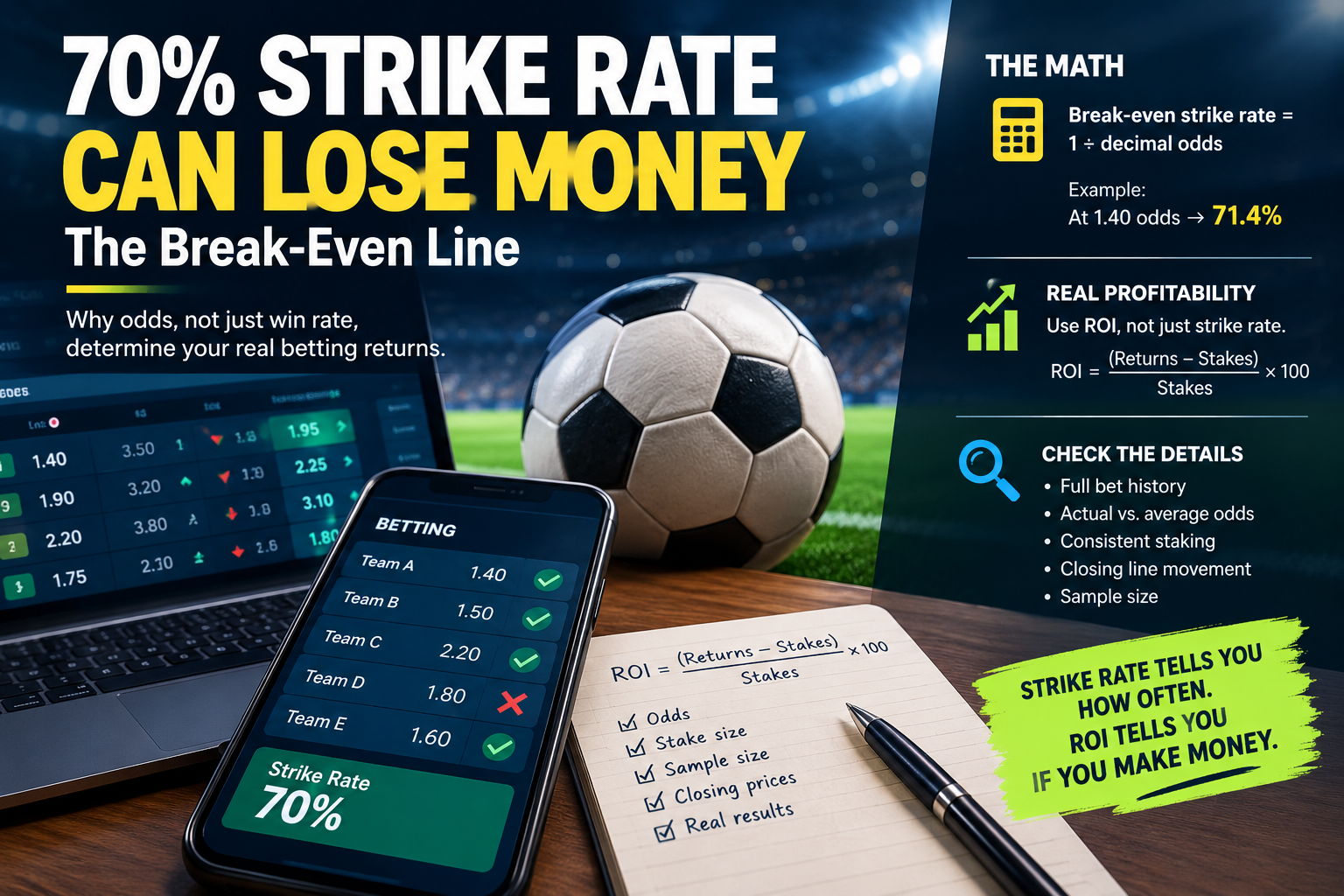
Every tipping service in the world leads with the same number. Strike rate. Won 7 of 10. Hit 82 percent last month. It is the first thing on the page because it is the easiest thing to understand, and it is close to useless on its own.
Strike rate tells you how often. It says nothing about at what price. And price is the whole argument.
Here is the line. At decimal odds of d, the strike rate you need just to break even is 1 divided by d. At 1.40, that is 71.4 percent.
So a service posting 70 percent at an average price of 1.40 is not slightly profitable. It is losing money, every month, while advertising a number that sounds excellent.
Three records, same arithmetic
Take a hundred tips from each of three services. Flat one unit stakes, no progression, no dutching.
Service A. Average odds 1.40, 70 winners. Returns are 70 times 1.40, which is 98 units back on 100 staked. ROI is minus 2 percent. The headline says 70 percent.
Service B. Average odds 2.20, 48 winners. Returns are 48 times 2.20, which is 105.6 on 100. ROI is plus 5.6 percent. The headline says 48 percent, which most people would scroll straight past.
Service C. Average odds 1.25, 82 winners. Break even is 80 percent, so this one clears the bar. Returns are 102.5 on 100, ROI plus 2.5 percent. A very high strike rate buying a very thin margin.
Service B is the only one of the three worth paying for and it has by far the worst looking number. That gap is not a curiosity. It is the entire reason strike rate is the headline metric on almost every tipping page you will ever land on.
The fix takes ten seconds. Multiply winners by average odds, divide by the number of tips, subtract one. That is ROI, and it is the only number that answers the question you are actually asking.
Average odds have to be real average odds
There is a trap inside the ROI calculation, and it is the reason you want the full bet list rather than a summary.
If a service posts mostly short prices and occasionally throws in a 9.00 longshot, the arithmetic mean of the odds is dragged upward by the longshots, and a headline ROI built on that average will flatter the record.
Ask for every settled bet with its price and its stake. Then compute returns bet by bet and add them up. If the list is not available, the record is a claim rather than a record.
Stake sizing hides the same problem. A record that looks profitable because three 5 unit plays landed while forty 1 unit plays lost is a record of three results, not forty three.
Recompute the whole list at flat stakes. If the profit disappears, what you were sold was a staking plan, and staking plans do not create edges. They only rearrange when you feel them.
The same applies to the price you can actually get. A tip posted at 2.20 that you take at 2.05 because you saw it forty minutes late is a different bet. Over a hundred tips, fifteen points of average price is the difference between Service B and Service A.
So check the gap before you subscribe rather than after. Take ten recent tips, find the same fixtures on the board you actually bet into, and see what is still available.
The market list at jacksclub.io/sports is one you can read without an account, which makes it easy to use as a reference point. If the prices you can reach are routinely worse than the prices in the record, the advertised ROI is not yours.
How many bets before the number means anything
This is the part that gets skipped, and it is the one that decides everything. Skill and noise look identical over a short run.
At around even money, a single flat stake bet has a standard deviation of roughly one unit. That is a fact about the shape of the bet, not about the tipster. Over n bets, the standard error of the average return shrinks with the square root of n.
Run the numbers on a genuine 5 percent edge. For that 5 percent to sit two standard errors clear of zero, you need n such that 0.05 times the square root of n equals 2. Square root of n is 40. So n is 1,600.
Sixteen hundred settled bets. That is what it takes to be reasonably confident that a 5 percent ROI is an edge rather than a warm streak.
Now look at what gets advertised. A 90 percent month usually means something like 18 from 20. The Wilson confidence interval on 18 from 20 runs from about 70 percent to about 97 percent.
The true strike rate behind that sample could plausibly be 71 percent, which at short prices is a losing service. Twenty bets tell you almost nothing, and they are always the twenty bets that get screenshotted.
The faster proxy: did the price move your way
Waiting for 1,600 bets is not practical. There is a shortcut that works much sooner, and serious bettors lean on it heavily.
Record the price when the tip is posted and the price at kick off. If the tip is consistently posted at 2.20 and the market closes at 2.00, the tipster is finding value before the market does, and that shows up long before the win column settles.
If the tip is posted at 2.20 and closes at 2.40, the market moved against it every time, and no amount of short term winning changes what that pattern means.
There is a reason this works. A closing price has absorbed team news, weather, suspensions and every currency unit that anyone was willing to risk on the fixture.
It is the market’s final answer. Anything that consistently sits on the right side of that answer is doing something the market had not yet done.
Beating the closing price is the single most reliable early signal of a real edge, because the closing price is the most accurate number any market produces all day. Thirty or forty tips is enough to see the pattern. Thirty or forty results is not.
Where you place the bet is part of the ROI
None of this survives contact with a bad account, and this is the piece that punters underweight most.
Price shopping is worth more than most tipping subscriptions. Fifteen points of average odds across a hundred bets at 2.00 is 7.5 percent of turnover, which is larger than almost any honest edge.
Settlement speed matters too, because a bankroll stuck in limbo for four days is a bankroll not turning over.
So treat the account itself as part of the calculation.
Check the margin the book takes on the leagues you actually bet, confirm how long it takes to get paid, and find out whether your stakes get cut once you start winning, because that last one ends more betting careers than bad tipping does.
There is a broader checklist on picking a betting site that covers margins, settlement and the things worth verifying yourself rather than taking on trust.
The audit, in four lines
Ask for every settled tip with date, selection, price and result. Not a summary.
Compute ROI bet by bet. Winners times price, minus total staked, divided by total staked.
Count the bets. Under a few hundred, treat the ROI as a rough estimate. Under fifty, treat it as a story.
Compare posted price with closing price on thirty recent tips. If the market moves toward the tip, you are probably looking at something real.
None of that needs a spreadsheet you cannot build in an afternoon. And it will separate the services worth paying for from the ones selling a percentage sign faster than any amount of reading the write ups.

