

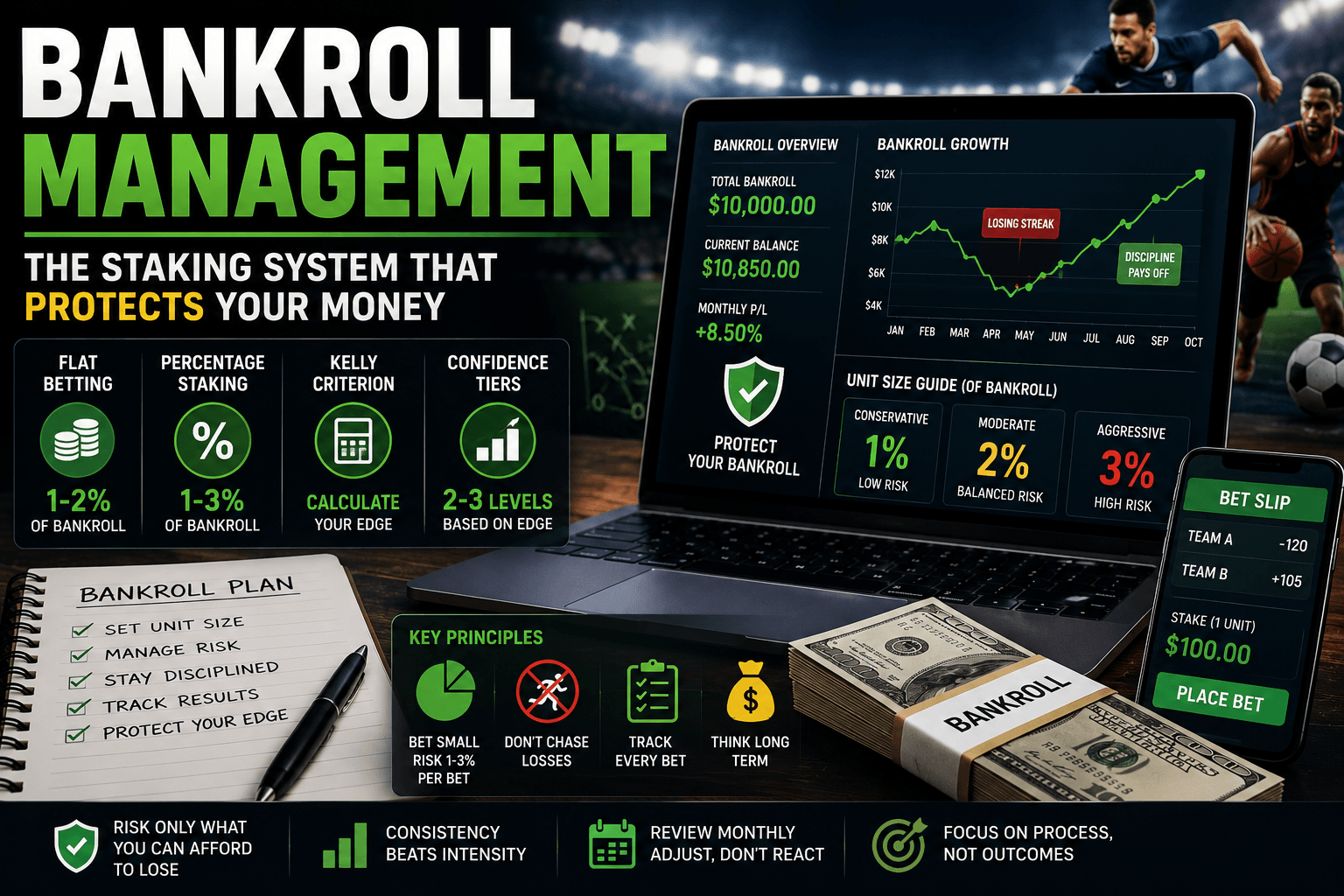
Ask any long-term winning bettor what separates them from someone who breaks even or loses steadily, and the answer is rarely “better picks.” It’s almost always bankroll management. Betting strategy gets all the attention, line shopping, model building, finding value but none of it matters if a single bad week wipes out the account before the edge has a chance to play out.
Most recreational bettors size their stakes on instinct: more money on games they “feel good” about, less on the rest.
This approach guarantees inconsistent results even when the underlying picks are genuinely profitable, because stake size ends up correlated with confidence rather than actual edge.
A disciplined staking system removes that emotional variable entirely and replaces it with a repeatable process.
Data from betting analytics platforms consistently shows the same pattern: bettors who use a fixed staking plan survive losing streaks that would otherwise end a season, while those who bet variable amounts based on gut feeling tend to blow up during the exact stretch where discipline matters most.
Platforms that track detailed betting statistics, including operators like winum casino, give bettors the historical data needed to actually measure whether a staking approach is working without that record-keeping, most bettors are simply guessing at their own long-term performance.
This is precisely why professional bettors treat bankroll tracking as seriously as they treat the picks themselves.
This guide covers the staking systems that actually work, how to size your bankroll correctly from the start, and the specific mistakes that quietly destroy most betting accounts.
Why Bankroll Management Matters More Than Pick Quality
Even a genuinely profitable betting strategy with a real long-term edge can go broke through poor staking. This isn’t theoretical — it’s basic variance.
Sports betting outcomes are inherently volatile in the short run, and a bettor with a 55% win rate at standard odds can still lose eight or ten bets in a row purely through normal variance.
If stakes are too large relative to bankroll, that streak ends the account before the edge ever materializes.
The core principle is simple: your bankroll needs to survive the worst realistic losing streak your strategy could produce, not just the average case.
This means calculating stake sizes based on bankroll percentage rather than fixed dollar amounts, so that losses automatically shrink your future stakes and wins automatically grow them — a structure that naturally protects against ruin.
Three numbers determine whether a staking plan is sound:
- Your total bankroll, defined strictly as money allocated only to betting, never money needed for expenses.
- Your edge, the realistic advantage your picks hold over the bookmaker’s odds — usually estimated conservatively.
- Your variance tolerance, meaning how large a drawdown you can psychologically and financially withstand without abandoning the strategy.
Comparing the Main Staking Systems
There isn’t a single “correct” staking system — the right choice depends on your risk tolerance, the size of your edge, and how actively you want to manage your stakes. The table below compares the four most widely used approaches among serious bettors.
| Staking System | How It Works | Risk Level | Best For |
|---|---|---|---|
| Flat Betting | Same fixed stake (e.g., 1-2% of bankroll) on every bet, regardless of confidence | Low | Beginners, long-term consistency |
| Percentage Staking | Stake scales as a fixed % of current bankroll, adjusting automatically with wins/losses | Low-Medium | Bettors wanting built-in bankroll protection |
| Kelly Criterion | Stake size calculated from your estimated edge and the offered odds | Medium-High | Experienced bettors with reliable edge estimates |
| Confidence-Based Tiers | Stakes vary across 2-3 preset levels tied to conviction, not gut feeling | Medium | Bettors with a proven, back-tested model |
Flat betting is the most forgiving starting point for anyone still building a track record, since it removes the temptation to overbet on “sure things” that turn out to be nothing of the sort. Percentage staking offers similar discipline while compounding bankroll growth more efficiently.
The Kelly Criterion, while mathematically optimal when your edge estimate is accurate, punishes overconfidence severely — most professionals use a fraction of full Kelly (often half or quarter) specifically to reduce this risk.
Setting Unit Size and Bankroll Limits Correctly
A “unit” is simply the standard stake size used across a staking plan, and getting this number right at the outset prevents most of the damage that ends betting careers. A widely used and well-tested framework looks like this:
- Separate your betting bankroll entirely from personal finances. This should be money you could lose completely without any impact on your life — never rent, bills, or savings.
- Set your unit size between 1% and 3% of total bankroll, depending on risk tolerance. Conservative bettors stay at 1%; more aggressive but still disciplined bettors go up to 3%. Above 5% per bet is generally considered reckless regardless of confidence level.
- Cap single-bet exposure even on “high confidence” plays at no more than 2-3x your standard unit. Uncapped confidence betting is the single most common cause of catastrophic bankroll swings.
- Recalculate your unit size monthly, not daily. Adjusting stakes after every win or loss introduces the same emotional bias that flat staking is designed to eliminate.
- Set a hard stop-loss threshold, such as pausing all betting if the bankroll drops 30-40% from its starting point, to force a strategy review rather than continued betting on autopilot.
Following this structure means a losing streak of even 10-15 bets — well within normal variance — remains survivable rather than account-ending.
Common Bankroll Mistakes That Undo Good Strategy
Even bettors who understand these principles in theory frequently violate them in practice, usually under emotional pressure. The recurring patterns worth naming directly:
- Chasing losses with bigger stakes. Increasing bet size specifically to recover a previous loss is the fastest way to turn a manageable drawdown into a blown bankroll.
- Parlaying to “catch up” after a losing stretch. Multi-leg bets compound variance dramatically and are a poor tool for recovering losses, regardless of how attractive the payout looks.
- Mixing bankrolls across sports or bet types without separate limits. A bettor might follow disciplined staking on football but abandon it entirely on same-game parlays or prop bets, undermining the whole system.
- Ignoring the difference between bankroll and account balance. A single sportsbook balance isn’t your full bankroll if you’re also betting elsewhere — track total exposure across every platform.
- Treating a winning streak as evidence to abandon the staking plan. Increasing unit size sharply after a hot streak is statistically no different from chasing losses; both replace a tested process with emotion.
Eliminating these five habits does more for long-term profitability than any single improvement to pick selection.
Final Thoughts
Bankroll management isn’t the exciting part of sports betting, which is exactly why most bettors underinvest in it. But the math is unambiguous: even a real, measurable edge can be destroyed by poor stake sizing, while a disciplined staking plan can keep a modest edge profitable through the inevitable losing streaks that variance produces.
Choosing a staking system that matches your risk tolerance, sizing your unit correctly from the start, and tracking results with the same rigor you apply to picking games is what separates bettors who survive long enough to realize their edge from those who never get the chance.

