

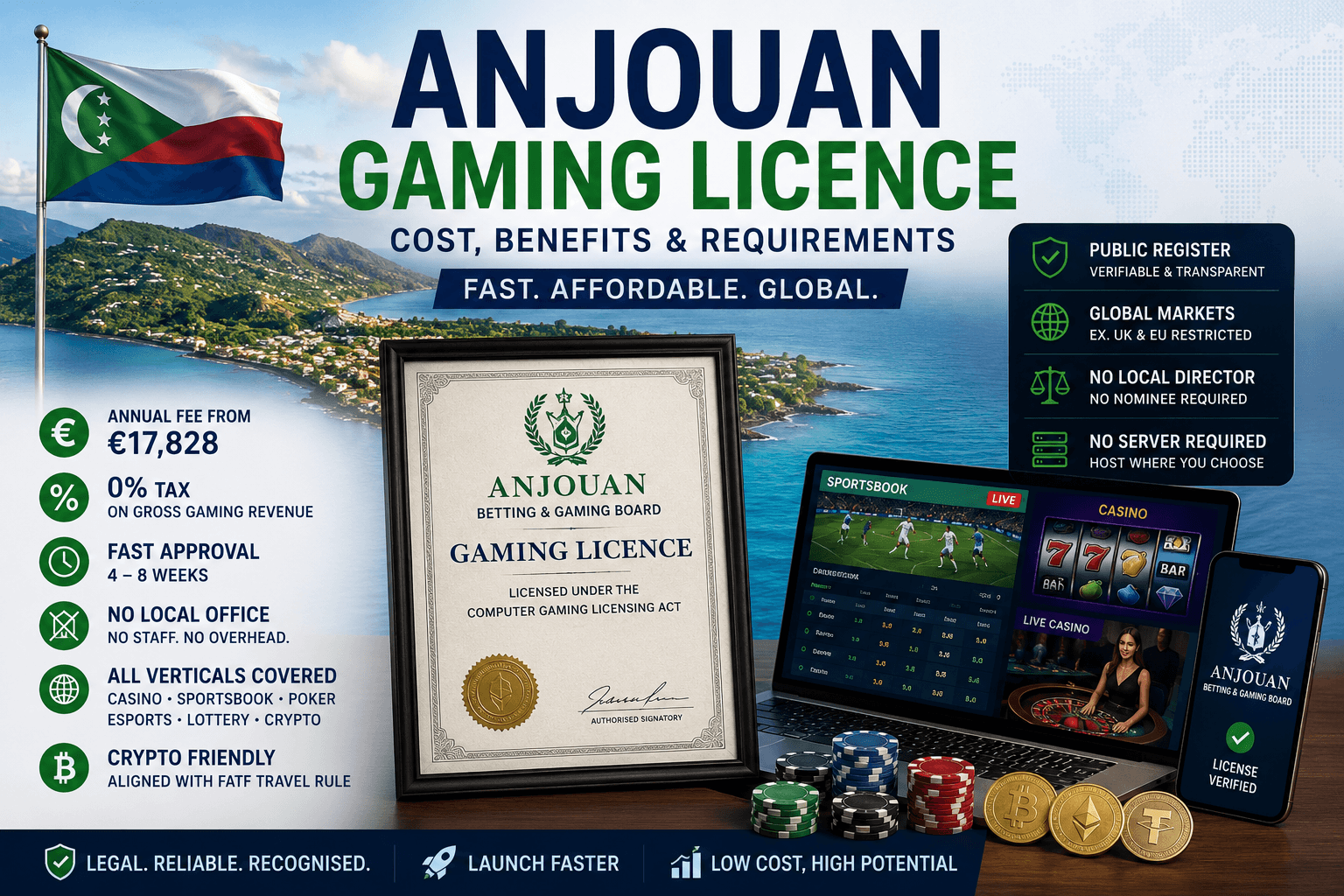
Ask what a gaming licence costs and you usually get a number that means nothing. The headline fee is the easy part. What decides whether a launch is viable is everything stacked behind it — the entity, the presence requirements, the tax on revenue, and the months you spend not trading.
Anjouan is worth looking at precisely because that stack is unusually short. Here is what it actually involves.
The headline number
The annual fee for an Anjouan gaming licence starts at €17,828. Tax on gross gaming revenue is 0%. For entities structured as IBCs trading internationally, there is no VAT or corporate income tax on top either.
That combination — a five-figure annual fee and nothing taken off the top line — is why the register keeps growing. It currently holds 1,425 active licences, with 348 issued this year alone, making it the fastest-growing offshore gaming register in the industry.
What you don’t pay for
The costs that sink first-time operators are rarely the licence fee. They are the obligations attached to it. Anjouan removes most of them:
- No physical office. Nothing to rent, staff or maintain on the island.
- No resident director. No local nominee to appoint and pay annually.
- No on-island server. No hosting requirement tied to the jurisdiction.
The applicant company itself is incorporated in Costa Rica, and the entire file is handled remotely. Nobody flies anywhere.
Compare that with Curaçao, which for years was the default. Since the LOK reform, a Curaçao application runs 8 to 16 weeks and requires a local entity, a resident director and a server on the island, with annual costs materially higher. Anjouan runs 4 to 8 weeks with none of those three. For operators who chose Curaçao on price and speed rather than on brand, the arithmetic no longer holds — which is exactly the migration the registers are recording.
One permit, every vertical
The other cost most people miss is fragmentation — paying for separate authorisations per product line. Anjouan does not work that way. A single permit from the Anjouan Betting & Gaming Board (ABGB), granted under the Computer Gaming Licensing Act, covers casino, sportsbook, poker, eSports, lottery and crypto, across both B2C and B2B.
That matters for a sportsbook that later wants to bolt on a casino, or a casino that wants to test eSports. No second application, no second fee.
Crypto: written in, not tolerated
Most offshore regimes treat crypto as an exception the regulator puts up with. A July 2025 revision aligned Anjouan with the FATF Travel Rule for virtual assets, which makes it one of the few permits where crypto deposits and withdrawals sit inside the framework rather than in a grey zone beside it.
There is a distinction here that trips up a striking number of applicants, and it is worth stating plainly: this is a gaming licence, not a VASP licence. It authorises a casino that happens to settle in crypto. It does not authorise an exchange or a custodian. Get that wrong and you have applied for the wrong permit entirely and start again.
The timeline, honestly
Four to eight weeks is the realistic range for a clean file. The variable is not the regulator — it is you. Files stall on three things, and they are always the same three:
- Corporate structure that doesn’t match what the regime expects.
- Local representation — applications must go through an authorised agent.
- Ongoing obligations that nobody planned for before approval landed.
None of these is exotic. All three are solved before submission or they are solved expensively afterwards.
Where it fits and where it doesn’t
Anjouan is not a substitute for a Tier-1 licence. It will not get you into the UK, and it will not get you into a regulated EU market. That is not a defect; it is the trade. You are buying speed, breadth and cost — not a seal that opens restricted territories.
What it does give you is a lawful, verifiable base to serve a wide span of international markets, with GEO-IP fencing to keep restricted territories out cleanly. Every licence sits on a public register, which means players and payment partners can check you rather than take your word for it — a small thing that turns out to matter a lot when you are opening merchant accounts.
The honest summary
For a startup, a crypto-first operator, or an established brand opening a second market fast, the numbers are hard to argue with: €17,828 a year, 0% on GGR, four to eight weeks, no local footprint, every vertical under one permit.
For an operator whose business case depends on UK or EU players, none of that is relevant and you should be looking elsewhere entirely.
The useful question is never “what does a licence cost”. It is “what does this licence let me do, and what does it stop me doing” — and on that question, Anjouan answers clearly.

